Wednesday, June 16, 2010

A Time For Choosing

A Time For Choosing

Robert Bryce, writing for Forbes magazine gives us all a serious dose of reality:

The Real Problem With Renewables

The growing oil spill in the Gulf of Mexico has, predictably, resulted in a new chorus of voices calling for increased use of renewable energy sources. But over the past five decades renewables have actually been losing market share.

In 1949 nearly 91% of America’s total primary energy came from coal, oil, and natural gas. The balance came from renewables, with hydropower being a dominant contributor. By 2008 the market share for coal, oil and natural gas, along with nuclear, had grown to 92.5% of total primary energy in the U.S. with the remainder coming from renewables.

Given the raging hype over renewable energy sources, those numbers, which are readily available from the Energy Information Administration, are remarkable. Over the past six decades tens of billions of dollars have been spent on renewable and alternative energy schemes such as wind energy, solar energy, corn and other biofuels, and electric cars. All have aimed at cutting our hydrocarbon use. And yet only nuclear power, which went from zero to about 8.5% of the U.S. primary energy over that time frame, has managed to steal significant market share from coal, oil and natural gas.

In other words, despite these huge investments, renewables’ share of the energy market has been shrinking. What’s happening? While conspiracy theorists may want to believe that Big Oil, Big Coal and Big Nuclear are stifling the growth of renewables, the simple truth is that coal, oil, natural gas and nuclear can satisfy the Four Imperatives: power density, energy density, cost and scale.

The Four Imperatives provide a simplified way to analyze the physics and math that rule our energy and its delivery, the latter better known as power. Before going further we must differentiate between energy and power. If you recall your high school physics, the definitions are straightforward: Energy is the ability to do work; power is the rate at which work gets done. Put another way, energy is an amount; power is a rate. And rates are more telling than amounts.

The first of the Four Imperatives, power density, is the most telling of the rates. Power density refers to the energy flow that can be harnessed from a given unit of volume, area or mass. Common metrics of power density include: horsepower per cubic inch, watts per square meter and watts per kilogram. And given the current infatuation with renewable energy sources like wind and solar, the essential metric for power density is watts per square meter (W/m2), which shows how much power can be derived from a given piece of real estate. It is also the metric that exposes the inherent weakness of sources like corn ethanol, wind energy and solar energy. If a source has low power density, then it will likely require too much real estate, material or space to provide the power that we demand at prices we can afford or in the vast quantities that the world needs.

The production of corn ethanol is a loser for many reasons. Just a quick glance at corn ethanol’s power density–just 0.05 W/m2–shows why the fuel makes no sense from a physics standpoint. Corn ethanol’s low power density is inherent in all biomass, which leads us to the second of the Four Imperatives. Energy density refers to the quantity of energy that can be contained in a given unit of volume, area, or mass. And the low energy density of biomass–corn, switchgrass, wood, etc.–makes it difficult to produce sufficient amounts of energy without occupying huge swaths of land.

Now let’s consider the power density of wind energy, which is about 1.2 W/m2, and solar photovoltaic, which can produce about 6.7 W/m2. Both sources are superior to corn ethanol (nearly everything is), but they are incurably intermittent, which makes them of marginal value in a world that demands always-available power. Nor can they compare to the power density of sources like natural gas, oil and nuclear. For instance, a marginal natural gas well, producing 60,000 cubic feet per day, has a power density of about 28 W/m2. An oil well, producing 10 barrels per day, has a power density of about 27 W/m2. Meanwhile, a nuclear power plant like the South Texas Project–even if you include the entire 19 square-mile tract upon which the project is sited–produces about 56 W/m2.

Simple math shows that a marginal gas or oil well has a power density at least 22 times that of a wind turbine while a nuclear power plant has a power density that is more than 8 times that of a solar photovoltaic facility. Those numbers explain why power density matters so much: if you start with a source that has low power density, you have to compensate for that low density by utilizing more resources such as land, steel, and ultra-long transmission lines. Those additional inputs then reduce the project’s economic viability and its ability to scale.

That can be understood by comparing the land use needs of a nuclear plant with those of a wind energy project or a corn ethanol operation. The two reactors at the South Texas Project produce 2,700 megawatts of power. The plant covers about 19 square miles, an area slightly smaller than the island of Manhattan. To match that output using wind energy, you’d need a land area nearly the size of Rhode Island. Matching that power output with corn ethanol would require intensive farming on more than 21,000 square miles, an area nearly the size of West Virginia.

Environmental groups and many politicians in Washington insist that the U.S. must lead the effort to develop renewable energy sources, with wind, solar and biomass being the lead components. But doing so will mean replacing high-power-density sources that are reliable and low cost with low-power-density sources that are highly variable and high cost.

The ugly oil spill in the Gulf may continue growing in size. In response the Obama administration may approve more projects like Cape Wind, the controversial offshore wind energy project in Massachusetts. And Congress may pass another energy bill that gives yet more mandates and subsidies for renewables, but try as it might, Congress cannot repeal the laws of physics.

Robert Bryce is a senior fellow at the Manhattan Institute. His newest book, Power Hungry: The Myths of “Green” Energy and the Real Fuels of the Future, was released last month.

Look, I’m an “all of the above” kind of guy on energy. I truly believe that we will always need oil and natural gas as our primary energy source. That’s why I support Sarah Palin and her efforts so vigorously. She understands that we need oil, natural gas, and coal, as well as nuclear energy and renewables.

It’s criminal that France gets over 75 percent of it’s electricity from nuclear powered generation plants, and we don’t. FRANCE!

From the World Nuclear Association:

France derives over 75% of its electricity from nuclear energy. This is due to a long-standing policy based on energy security.

France is the world’s largest net exporter of electricity due to its very low cost of generation, and gains over EUR 3 billion per year from this.

France has been very active in developing nuclear technology. Reactors and fuel products and services are a major export.

It is building its first Generation III reactor and planning a second.

You can read more about what can only be described as an incredible success story here.

Frankly, this is embarrassing to no end. How in the hell can America, the greatest nation the world has ever known, sit back and let FRANCE lead the world on nuclear energy production?!?

The environmental moon-bats go crazy when you mention nuclear as a source of energy, but America has had nuclear powered submarines for almost 60 years and nuclear powered aircraft carriers for almost 50 years without incident.

The United States launched the USS Nautilus, the first nuclear submarine, in 1954. Nautilus could circle the world underwater for up to four months without resurfacing.

USS Enterprise (CVN-65): 93,500-ton nuclear-powered supercarrier commissioned in 1961. First nuclear-powered aircraft carrier. Scheduled for decommissioning in 2013, may be extended to 2014-2015.

My thinking is a nuclear power plant on the ground is a heck of a lot safer than one in combat conditions, and yet, here we are.

Why aren’t we building nuclear plants at the rate Starbucks was throwing up coffee shops at one point?

Stupidity!

I think Cracked Magazine (of all places) got it absolutely right in this article:

The 5 Most Ridiculously Over-Hyped Health Scares of All Time

# 5 Three Mile Island

On March 28, 1979, what should have been a minor plumbing problem somehow escalated into a reactor fuel meltdown at the Three Mile Island Nuclear Station in Pennsylvania. Within five days, the Governor had ordered the evacuation of all children and pregnant women, within a five-mile radius of the area. Since that time, the name Three Mile Island has been synonymous with nuclear disaster. Hooters even named one of their hottest (and most delicious) wing sauces after it!

But unlike other nuclear disasters, Chernobyl for example, which caused at least 4,000 eventual deaths, Three Mile Island was responsible for a whopping zero fatalities. In fact, there weren’t even any injuries. Later tests revealed that the level of radiation people were exposed to in the five-mile radius was equivalent to the amount of radiation a person is exposed to while flying on a commercial airliner. In other words, the danger was nil.

So why all the ruckus? Much like that restraining order Catherine Zeta-Jones slapped us with a few years back, we blame Michael Douglas for this.

Just 12 days prior to the incident at TMI, The China Syndrome premiered. In the film, Michael Douglas plays a television news reporter who surreptitiously films a nuclear power plant crew as a near meltdown is taking place. As luck would have it, the events depicted in the movie almost perfectly mirrored what occurred at TMI. With the movie stirring public debate about the safety of nuclear power, there was no way the incident at TMI occurring just days later would do anything less than scare the ever-loving crap out of people. And that’s exactly what it did.

In 1979, Three Mile Island killed fewer people than ….

ROBOTS ATTACKS!

Ford factory worker Robert Williams was killed when a robot hit him in the head, thus outranking Three Mile Island’s death toll, 1-0.

This is a great piece on a lot of stupidity by politicians, environmentalists, and so on. You can read about all 5 here, though I must throw out a language warning for our more genteel readers.

Look, Obama is asking the wrong question. The question is not why we can’t get off of oil. Nope, the real question Obama and the nation should be asking is:

If we can put a man on the moon, why can’t we beat the French and get more than 75 percent of our electricity from nuclear?

Grouchy Old Cripple

Grouchy Old Cripple
joke
Jimmah Carter joke updated to Obumfuck.

Why does JHE always lay on the bottom during sex?

Because all he knows how to do is fuck up.

Net Oil Importers � Crude Oil Peak

Net Oil Importers � Crude Oil Peak

List of graphs of net oil importers

The Oil Drum | BP's Deepwater Oil Spill - Why the Flow Rates are Increasing and Open Thread 2

The Oil Drum | BP's Deepwater Oil Spill - Why the Flow Rates are Increasing and Open Thread 2

For the Rock's of the world who don't have time to read the docs...

Fracture Zone Measured Depth 18305.0 ft
Fracture Zone Gradient 0.779 psi/ft
Fracture Zone Density 15.00 Ib/gal
Fracture Zone Pressure 14255 psi
Reservoir Measured Depth 18200.0 ft
Reservoir Pore Pressure 13197 psi
Reservoir Zone Gradient 0.726 psi/ft
Reservoir Zone Density 13.97 Ib/gal
Back Pressure 0 psi
Height - Mud Line to Mean Sea Level 4992.0 ft
Height - Mean Sea Level to Rotary Kelly Bushing 75.0 ft
Sea Water Density 8.54 Ib/gal
Returns To Surface
Simulator Volume Increment 5.00 bbl
Surface Iron Displacement 0.41 bbl
Shoe Track Length 189.0 ft
Additional Pressure to Seat Plug 500 psi
Eccentricity Enhanced Calculations No
Erodibility Enhanced Calculations Yes
Mud Erodibility Measured Depth 17168.0 ft
Mud Erodibility Number 20.69
Mud Required Shear Stress 29.00 Ibf/(100*ft2)

Most of the hole is 'relatively' straight (<1>

The Oil Drum | BP's Deepwater Oil Spill - Why the Flow Rates are Increasing and Open Thread 2

The Oil Drum | BP's Deepwater Oil Spill - Why the Flow Rates are Increasing and Open Thread 2

BP's Deepwater Oil Spill - Why the Flow Rates are Increasing and Open Thread 2

Because of the large number of comments, this is another copy of last night's post.

Tonight [Now, last night] the President will talk to the nation about the oil disaster that has been going on in the Gulf of Mexico for over a month. That will likely be the news story of the night, followed by the answers to the five questions that lawmakers have of BP. By that time I will also be starting a daily visit to the National Hurricane Center to see if there are any signs of coming problems. All of which being said, now might be a good time to talk about erosion, how it is changing the Deepwater Horizon well conditions, and why precautions about the flow increasing are probably wise. And I am going to recap bits of an old Tech Talk, as I do so. (It’s partly why they are there.)

To begin with a simple point – fluid (oil and gas) will only move from one place to another if something is pushing it. (Newton’s first law). For the fluid in the reservoir under the Gulf, this force pushing the oil out is the difference in pressure between the oil in the rock, and the pressure in the well. The pressure of the oil in the rock is 12,000 psi. When the well was drilled the pressure of the mud that filled the well was over 13,000 psi and no oil moved into the well. Just before the disaster the fluid in the well was changed from mud to seawater. This lowered the pressure of the fluid in the well below that of the fluid in the rock, a differential pressure now existed, and where there was a passage through which the oil and gas could flow, and they did. The question has always been – how much?

Gas flows more easily through cracks than oil, and the disaster was first evident when leaking gas reached the drilling rig, and then ignited. The BOP then, at least partially, functioned. After the rig sank, the riser also sank, bending the pipe just above the BOP. At that time there were reports that a Coast Guard ROV examined the underwater assembly and did not see any obvious oil leaks. A couple of days later the flow was suggested at about 1,000 bd, and this then escalated to 5,000 bd. As cameras began to publicly monitor the outlet of the riser the estimates started to grow, but a not-well-publicized effort measured the flow out of the riser, and found that it was around 8,000 bd, with allowance for leaks, the overall flow was estimated to be perhaps 12,000 bd. Once the broken part of the riser was removed and a cap placed over the well, a significant portion of the escaping oil was captured and could then be measured as it flowed into the surface vessel recovering it. Those values are currently at around 15,500 bd. BP is currently planning on additional capture this week of up to another 10,000 bd, and preparing for a worst case scenario with a flow rate of 80,000 bd. These numbers vary a lot, and yet they could all be correct.

Why? Well, its called erosion, and simply put, the oil and gas that are flowing out of the rock are bringing small amounts of that rock (in the form of sand) out with them. Rocks that contain lots of oil are not that strong and are easily worn away by the flow of fluid through them.

Let me make an analogy with soil. If I make a hill of soil, and leave it sit for a while there will be a number of rainstorms fall on the soil. Initially the surface will all erode relatively evenly under the diffused flow after the rain, but very quickly weaker parts of the soil will be removed faster and instead of a smooth surface, the soil will be selectively eroded and channels or rills will start to form on the surface.


Hillside rill channels formed as initially diffuse rainwater water flow concentrates and erodes channels

These are larger than the passageways around the individual grains of soil, and so it is easier for the water to flow in these channels, and so more water collects in them and moves through them. As it does, because the fluid can easily get around the soil particles, and this was a weaker area already, more soil is removed, and the channels get deeper. This is known as concentrating the flow and means that, over time the channels grow bigger, the fluid flows faster, and it has a greater potential for erosion.

This also happens when oil and gas start to flow from a reservoir. It is generally not a good thing to allow, since the sand is still in the oil and gas when it reaches the surface and it is expensive to get out – as well as causing the problems I am about to talk about. So to stop it, the well is fitted with a screen when it is first opened. The screen holds the rock particles (sand) in place around the well, slowing if not completely stopping the creation of the channels.

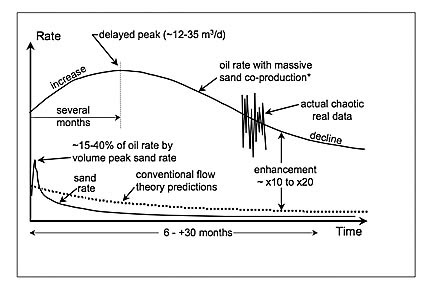
But sometimes, the deposit doesn’t flow very well, the oil may be heavier, or there may be other reasons, and in this case allowing those channels to develop can help production. This technique is known as CHOPS – Cold Heavy Oil Production with Sand. (The report cited is a multi-chapter pdf). The impact of allowing the sand to flow with the oil and gas (to be produced in the terminology) is very significant.


Simplified change in production from a well with the sand being produced (upper curve) relative to conventional flow (lower curve). (The curves have been smoothed and only a sample of the “noisy” data is shown). Government of Alberta CHOPS Report

There is thus a very good reason, from the oil in the rock point of view, for the production to have been increasing the way that it has. And for it to increase to the levels that BP are taking precautions to capture. And because they cannot get access to the flow channels to restrain their growth and hold the sand until the relief wells are drilled that increase may well be unavoidable.

Now to the second part of the puzzle, which is what that sand does to the flow passages. The DOE release of some of the documents from BP included pressure measurements at different points along the BOP as taken on the 25th of May.

Pressures along the BOP on May 25th (DOE )

Because of the erosion, values only exist transiently, so dates become important.

When I cut with an abrasive slurry system, the jet flows through a nozzle that is about 1 mm in diameter (0.04 inches). With a pressure drop of 5,000 psi across the nozzle, that jet, once formed, will cut through casing steel in around 15 seconds. It will cut through ASTM – A108 steel to a depth of over an inch at a traverse speed of 1.5 inches a minute. (Cement is much easier to cut). In this way very small initial openings are very easily made wider, to allow a greater volume flow. (And for those who assert that changing material properties will stop erosion, one of my upcoming papers deals with what happens to diamond.)

The pressures across the BOP don’t show the pressure drops that they did earlier in this disaster. At one time it was reported that the pressure below the BOP was in the 8-9,000 psi range and that above it 2,800 psi with the 2,250 psi pressure being that of the seawater outside the riser. At that time I calculated that a flow of 500 gallons per minute (17,000 bd) would only require a gap in the range of 0.5 to 0.7 inches in effective diameter to allow that flow, at that pressure drop.

The pressure below the BOP is now at 4,400 psi with a pressure drop of around 2,150 psi which will slow the erosion significantly – but not totally. For that pressure drop to have occurred, for the same flow rate, the effective equivalent diameter through the BOP need only increase by 0.1 inches to 0.8 inches, which is not a lot. Were the effective diameter to increase by only another 0.15 inches the flow would increase to 25,000 bd, and if the effective diameter were to double to about 1.7 inches, then the flow would reach the maximum capacity that BP will be able to handle of 80,000 bd. Given the steady erosion that the BOP is seeing, and the fact that a slow erosion rate over time still gets to a large enough diameter, perhaps it is not foolish of BP to bring in that additional capture and storage capacity.

And since a picture sometimes helps, the following picture shows a single ASJ jet at 5,000 psi cutting the walls of the OmniMax Theater under the Gateway Arch in St Louis. We cut the full 15 ft of the new wall exposure with the system (to make the hole for the theater to be put into). The jet flow rate was around 5 gpm.


And this was the cut after a single pass, we were cutting about 18 inches deep on a cut (rock and cement cut a lot easier than metal – though we accidentally ran over a couple of those bolts and cut them right off).

Dolomite and chert cut with an ASJ in the walls of the Omnimax Theater under the Arch in St Louis. (Its all hidden behind the concrete wall now).

Now you will notice that this says nothing about those ideas such as that propounded by Dougr that the casing has been cracked and oil is escaping into the surrounding rock., and that the casing is becoming a lot weaker. There are two reasons for this, firstly if there was a crack, in the same way as with the BOP, then over time that would have been eaten away as oil, gas and mud flowed through it. Once a flow starts it will rapidly eat out a larger passage, as the above has demonstrated. Once that passage was created then oil flow through it to the surface would make it impossible to see what was going on around the well (look at the cloud above the BOP). In fact there are very clear pictures from under the BOP. This would seem to show that there is no oil leaking there at present.

The other thing to remember is that BP are planning on using the second LMRP cap effectively as a seal on the well. They could not do that if the upper segments of the casing were damaged, and I imagine that they have enough data from the Top Kill testing to reassure themselves of that.

Sense of Events: How bad will the Oil Spill get?

Sense of Events: How bad will the Oil Spill get?

How bad will the Oil Spill get?

By Donald Sensing

According to this oil industry expert, worse than you have ever imagined.

Well...none of what is likely to happen is good, in fact...it's about as bad as it gets. I am convinced the erosion and compromising of the entire system is accelerating and attacking more key structural areas of the well, the blow out preventer and surrounding strata holding it all up and together. This is evidenced by the tilt of the blow out preventer and the erosion which has exposed the well head connection. What eventually will happen is that the blow out preventer will literally tip over if they do not run supports to it as the currents push on it. I suspect they will run those supports as cables tied to anchors very soon, if they don't, they are inviting disaster that much sooner.

Eventually even that will be futile as the well casings cannot support the weight of the massive system above with out the cement bond to the earth and that bond is being eroded away. When enough is eroded away the casings will buckle and the BOP will collapse the well. If and when you begin to see oil and gas coming up around the well area from under the BOP? or the area around the well head connection and casing sinking more and more rapidly? ...it won't be too long after that the entire system fails. BP must be aware of this, they are mapping the sea floor sonically and that is not a mere exercise. Our Gov't must be well aware too, they just are not telling us.

All of these things lead to only one place, a fully wide open well bore directly to the oil deposit...after that, it goes into the realm of "the worst things you can think of" The well may come completely apart as the inner liners fail. There is still a very long drill string in the well, that could literally come flying out...as I said...all the worst things you can think of are a possibility, but the very least damaging outcome as bad as it is, is that we are stuck with a wide open gusher blowing out 150,000 barrels a day of raw oil or more. There isn't any "cap dome" or any other suck fixer device on earth that exists or could be built that will stop it from gushing out and doing more and more damage to the gulf. While at the same time also doing more damage to the well, making the chance of halting it with a kill from the bottom up less and less likely to work, which as it stands now?....is the only real chance we have left to stop it all.

It's a race now...a race to drill the relief wells and take our last chance at killing this monster before the whole weakened, wore out, blown out, leaking and failing system gives up it's last gasp in a horrific crescendo.

We are not even 2 months into it, barely half way by even optimistic estimates. The damage done by the leaked oil now is virtually immeasurable already and it will not get better, it can only get worse. No matter how much they can collect, there will still be thousands and thousands of gallons leaking out every minute, every hour of every day. We have 2 months left before the relief wells are even near in position and set up to take a kill shot and that is being optimistic as I said.

Over the next 2 months the mechanical situation also cannot improve, it can only get worse, getting better is an impossibility. While they may make some gains on collecting the leaked oil, the structural situation cannot heal itself. It will continue to erode and flow out more oil and eventually the inevitable collapse which cannot be stopped will happen. It is only a simple matter of who can "get there first"...us or the well.
And he thinks it will be the well. How much oil could blow into the Gulf if there is a total failure of the wntire wellhead and its seabed substructure? Possibly billions of barrels. That makes listening to the president's address tonight with an analytical ear even more important.

Sunday, May 30, 2010

Procrastination hack: '(10 2)*5' | 43 Folders

Procrastination hack: '(10 2)*5' | 43 Folders

Procrastination hack: '(10+2)*5'

Following on the idea of the procrastination dash and Jeff’s progressive dash, I’ve been experimenting with a squirelly new system to pound through my procrastinated to-do list. Brace yourself, because it is a bit more byzantine than is Merlin 2005’s newly stripped-down habit. It’s called (10+2)*5, and today it will save your ass.

Who it’s for

(10+2)*5

  • procrastinators
  • the easily distracted
  • compulsive web-surfers
  • people with a long list of very short tasks (a/k/a “mosquitos”)
  • people having trouble chipping away at very large tasks

What you’ll need

  1. a timer
    • must be easy to reset
    • electronic kitchen timer is particularly good (pref. with multiple alarm memories), or
    • an app like Minuteur (get the newest version—several cool new features)
  2. a reduced subset of your to-do list
    • tasks that can be worked on (not necessarily completed) in blocks of 10 minutes or less
    • GTD people: next actions only, please
  3. an hour of your time (less is potentially okay, but it’s non-canonical)
  4. your sorry, procrastinating ass

How it works

It’s called “(10+2)*5” and here’s why:

  • 10 - Work for ten minutes with single-minded focus on moving toward completion on a single task. Ten minutes, and that’s all you’re allowed to do is work, work, work. No cheating, because (DING!) you actually get a break when you’re done…
  • 2 - After ten minutes of sweaty, dedicated work you get a 2-minute break to do whatever you want—drink coffee, read 5ives, call your bookie, whatever. When the two minutes are up, it’s back to work on the next task on your list. This is important.
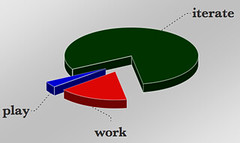
  • *5 - You’re going to iterate this four more times for a total of one hour’s working/breaking

Important squirrely rules

  • You do not need to finish your task or your project in ten minutes; you just need to move it forward
  • If you finish a satisfying amount of work in fewer than ten minutes, STOP, and go right to your 2-minute break, than start another 10-minute dash
  • Do NOT skip breaks! You are not allowed. Breaks cannot be missed. Period. Go surf the web. Now. Seriously. GO!

What will happen

You’ll blaze through an hour’s worth of work/not work and will find yourself looking forward to both the breaking and working parts of the cycle. (Dang, how’s that for a change?)

The MacGuffin

The Now Habit
by Neil Fiore

Okay, you caught me. That’s the hack: you can and eventually will skip breaks.

In his (extremely wonderful) The Now Habit, Neil Fiore suggests a similar habit of “unscheduling,” where you only make obligations to the things that you enjoy and that are not the source of procrastination. John Perry suggests “Structured Procrastination,” where you only give high priority to “unimportant” tasks. Of course, this is taken to a hilarious extreme with Joshua Newman’s plan for scheduling just a few minutes of work per hour, and then focusing on the “more important” tasks like DVD re-arranging.

Thursday, May 27, 2010

sad truth we need oil drillers "more than they need us" james altucher says: Tech Ticker, Yahoo! Finance

sad truth we need oil drillers "more than they need us" james altucher says: Tech Ticker, Yahoo! Finance

The Oil Drum | Drumbeat: May 27, 2010

The Oil Drum | Drumbeat: May 27, 2010

"BP sets stage for Disaster"

No oil and gas well ever drilled has gone exactly to plan, or without mistakes being made. The Upstream Industry has learned the hard way. The path to todays drilling (well construction) approach is littered with terible loss events, and awash with lessons. But the fact is that todays drilling approach allows for mistakes to be made, simply because wells do not always behave as planned, and the execution of each step of the well construction plan relies on people. Contingency measure after contingency measure is layered over the average well construction plan such that if one, two, three, or even more consecutive issues occur and stack up against the well construction team there remains the cability on hand to identify there is a problem, to secure the well, and to plan and effect an appropriate remedial plan.

Yes a number of issues were stacking up against the well contruction team on Mississippi Canyon 252 #1-01 well on the night of the tradgey. Issues such as a communication path between the reservoir (oil and gas) and the well bore, the choice of casing plan and related well barriers, etc. However up until around 21:45 there remained the cability on hand to identify there was a problem, to secure the well, and to plan and effect an appropriate remedial plan to deal with the issues that had stacked up.

Unfortunately, at around 21:47 the Annular BOP opened releasing the immense energy that had accumulated beneath it (gas), energy that on release evacuated (ejected) the drilling riser of fluids in seconds. Thousands of gallons of fluids entering the workspace (drill floor) at almost jet force would have made any subsequent action to try to regain control of the well very difficult.

Much has been made about the issues that stacked up against the well construction team on that night, the cement program, the cement quality, the casing program, the testing program, etc etc, however the point remains that until around 21:45 the team still had the ability on hand to identify there was a problem, to secure the well, and to plan and effect an appropriate remedial plan to deal with the issues that had stacked up. The BOP Annular was closed and was capable of containing pressure build up as a result of the leak path between the reservoir and the well bore. There were other BOP Ram Preventers available of high pressure rating than the BOP Annular Preventer to call upon if required. With this contingency at hand (the last layer of contingency in any well construction plan), why did it still go so wrong?

I would offer that the real question is why did the BOP annular open? Did it fail? Was it opened by mistake? Was it opened thinking there was no hazardous gas build up below it? The investigation team will undoubtedly determine the truth.

I can also offer that in the Drilling Industry the Driller (the man that operates the drilling machine integrated into the rig structure) has two Golden Rules when it comes to well control:
#1, if there is any doubt whatsoever about a possible influx of formation fluid into the well bore then the well must be shut in (close the BOP), he requires approval from no-man for this action
#2, if the BOP has been closed for whatever well activity the Driller must be assured that doing so will not result in a hazardous situation for him, his team and all with him at the worksite. He requires approval from the worksite supervisors for this action.

The mud logger charts (main drilling parameter record) for the period 20:00hrs through 21:50hrs as presented at the Senate hearing show clear indicators of a problem with the well. There was more flow coming back from the well than going in, there was additional pressure where there should not have been. Evaluation and interpretation of these charts is an essential part fo providing the Driller the assurance he needs that opening the BOP Annular will not result in a hazardous situation.

If the BOP Annular was opened by the well construction team the other question undoubtedly being asked by the investigation team is whether suitable and sufficient evaluation and interpretation of the drilling parameter records was undertaken prior to authorising the opening of the BOP Annular?

The time line on the mud logger chart suggests around 15 minutes (from 21:30hrs to around 21:45hrs) may have been available for the well construction team to evaluate and interpret why there was pressure under the BOP Annular when there shouldnt have been.

15 minutes is not a long time to consider this kind of situation. Given that there had been a number of issues going on with this well since the casing was run and cemented (a lot of red flags were flying) there should have been the highest degree of awareness on every subsequent step of the operation. This means the full attention of all supervisors at all times. So, assuming again that the BOP Annular was opened by the team, why was there only a few minutes spent deciding the next step when the biggest red flag of them all (pressure under the BOP Annular) was waving.

Thanks for reading.

Blowout

Saturday, May 22, 2010

oil-halliburton-cement-052010jpg-e618a2271a66c847.jpg (JPEG Image, 570x1024 pixels)

oil-halliburton-cement-052010jpg-e618a2271a66c847.jpg (JPEG Image, 570x1024 pixels)

Well bore sketch possible entry thought blowout Horizon

Obama's An Idiot

Obama's An Idiot

Joke

More Truth Than Bullshit

Barack Obama met with the Queen of England.

He asked her, "Your Majesty, how do you run such an efficient government? Are there any tips you can give to me?"

"Well," said the Queen, "the most important thing is to surround yourself with intelligent people."

Obama frowned, and then asked, "But how do I know the people around me are really intelligent?"

The Queen took a sip of tea. "Oh, that's easy; you just ask them to answer an intelligent riddle." The Queen pushed a button on her intercom. "Please send Tony Blair in here, would you?"

Tony Blair walked into the room and said, "Yes, my Queen?"

The Queen smiled and said, "Answer me this please, Tony, your mother and father have a child. It is not your brother and it is not your sister. Who is it?"

Without pausing for a moment, Tony Blair answered, "That would be me."

"Yes! Very good," said the Queen.

Obama went back home to ask Joe Biden, his vice presidential choice the same question. "Joe, answer this for me. Your mother and your father have a child.
It's not your brother and it's not your sister. Who is it?"

"I'm not sure," said Biden. "Let me get back to you on that one.." He went to his advisors and asked every one, but none could give him an answer. Finally, he ended up in the men's room and recognized Colin Powell's shoes in the next stall.

Biden asked Powell, "Colin, can you answer this for me? Your mother and father have a child and it's not your brother or your sister. Who is it?"

Colin Powell yelled back, "That's easy, it's me!"

Biden smiled, and said, "Thanks!" Then, he went back to speak with Obama. "Say, I did some research and I have the answer to that riddle. It is Colin Powell!"

Obama got up, stomped over to Biden, and angrily yelled into his face, "No! You idiot! It's Tony Blair!"

AND THAT MY FRIENDS IS WHAT'S WRONG WITH OUR GOVERNMENT.

Tuesday, May 18, 2010

Possible non-OPEC oil supply surge to put pressure on prices?

Possible non-OPEC oil supply surge to put pressure on prices?

To be sure, data points from only two years shouldn’t make us rush to believe that world oil is undergoing a shale gas type surge in productive capacity. In fact, it’s not. Analysis strongly suggests that the production surge in 2009 and 2010 will not repeat; in other words, non-OPEC oil output is not expected to grow in 2011 and the foreseeable future. So, against a backdrop of resurgent demand from emerging economies that means that a bias to higher oil prices over the next 12 to 24 months remains (notwithstanding another economic meltdown).

Yet those in the oil business shouldn’t be too complacent in recognizing the significance of the mini-tsunami of non-OPEC oil that hit the markets in 2009, at the same time as the financial crisis washed out the demand side. In fact, it was OPEC that took excess barrels off the market, sacrificing market share, which is why the cartel’s collective spare productive capacity tripled in the past two years, going from 2.0 MMB/d to 6.0 MMB/d.

Looking back five years ago, the opening words to my book, A Thousand Barrels a Second, were, “We are not running out of oil. We are running out of cheap oil.” Implicit in these words were that price of this vital commodity had to rise up from the then $30.00/B, because of looming scarcity in the face of rising demand.


Read more: http://www.calgaryherald.com/business/Possible+OPEC+supply+surge+pressure+prices/3037511/story.html#ixzz0oIedA3fc

Friday, May 14, 2010

The Oil Drum | Crystals, the Gulf of Mexico Blowout, and the new 'Top Hat' Dome

The Oil Drum | Crystals, the Gulf of Mexico Blowout, and the new 'Top Hat' Dome

hydrates and scale

The Oil Drum | Is 70,000 barrels a day a possibility for the oil spill?

The Oil Drum | Is 70,000 barrels a day a possibility for the oil spill?

I still haven't seen it.

The seal assembly in the wellhead was tested to 10,000.

Prior to displacing the riser, a positive pressure test held.

The negative pressure test showed 1,400 psi on the drillpipe and 0 psi on the choke and kill lines. If the drillpipe contained seawater and the choke and kill lines contained mud prior to displacing the riser than this is exactly what the pressure should read.

In the last 120 seconds something let go and the standpipe pressure went from 1,500 psi to 5,800 psi. I can't imagine what the men on the rig floor were going through then.

FF

Monday, May 03, 2010

The Oil Drum | Tech Talk: Progress on the Gulf oil leak and comments on cementing pipes and well completion

The Oil Drum | Tech Talk: Progress on the Gulf oil leak and comments on cementing pipes and well completion
Permalink | Subthread  | Comments  top

Kheris, great find, thanks for digging this up and posting the link.

It's an eyewitness account from two guys out tuna fishing right below the Deepwater Horizon on the night of April 20th. One of the guys had worked offshore, and from the story, that experience probably saved his life, as he knew what the "kick" they were watching meant, and yelled for his buddy to get their boat away from their fishing spot by the platform ASAP, which they did.

I've excerpted the following verbatim, with spelling/grammar errors as is, from this account that Kheris linked to above.

ROCKMAN; as I read through the story that these two tell, it sure sounds like the unconfirmed report you heard and which you posted around 12:30 pm today, which is that someone on the platform missed seeing the well kicking back at them until the ship reported the disconnect between the tanks full of mud vs. the amount of mud that should have been pumped, is a very plausible explanation. And, when someone up top did recognize the kick, it was too late. Methane was already venting (the eyewitness account of the decibel level is scary), and when power was cut the backup system started up but sparked, and that caused the initial explosion.

Their observations are VERY interesting, and if these two eyewitnesses are right, it was the start-up of the backup electrical power system that caused the initial explosion:

Around 10pm the entire center of the rig started rushing water downwards over all the pipes... I've never seen such an event take place. I looked at my friend who previously worked offshore, and he said that's BOP something another and the rig took a 'kick!' I thought the rig was sinking and that was their way of bilging... But nope! Methane gas began BLOWING out of the West side of it and the noise of the thrust was louder than anything I've ever herd (except for a sonic boom I herd once, and what I'm about to tell you next) My eyes began to burn and that friend I was telling you about earlier began to SCREAM, "GO, GO, GO, GO, GOOOOO!" I positioned my compass North and put the gears in WOT! At approximately 100 yds from the rig it Exploded! Puts a new meaning to explosion.

The rig continued EXPLODING. A very large crew boat was tied to the rig as it blew and the ppl began rafting to that boat as it floated away slowly. I got on the radio to try to help and they told me to stay away for safety. The rig blew a few more explosions after that and began to burn down. Some of the rig began dripping into the water and the platform tilted in and turned RED HOT.

When the gas started blowing out the side of the rig they turned off the power to prevent electrical spark which would ignite the gas, but when they shut power the generator kicked on and thats all she wrote!

The Oil Drum | Tech Talk: Progress on the Gulf oil leak and comments on cementing pipes and well completion

The Oil Drum | Tech Talk: Progress on the Gulf oil leak and comments on cementing pipes and well completion

I DO NOT HAVE CONFIRMATION OF WHAT I’M ABOUT TO SAY!!!!

Did everyone hear that? Maybe true…maybe just BS. But just heard a story re: the displacement of the drilling mud with sea water from the riser. The mud was being pumped into a boat at the rig. Normal procedure. But at one point the boat captain notified the rig his tanks were almost full. But that didn’t match the volume of mud that could have been pumped in the time span.

What this might mean: when you’re drilling and you stop to add a new section of drill pipe you monitor the return mud tank. When you stop your mud pumps, the flow of mud from the well bore should also stop. If it doesn’t then something down hole must be pushing the mud up and out… oil/NG/water or any combination. That’s why you do a “flow check”. To make sure the hole is static. Pure speculation on my part based upon the unconfirmed report of excessive mud pumped to the boat: the well started coming in and no one was monitoring the flow back. There are also electronic monitors to watch for this but they don’t work very well (or at all) during such an offloading op.

But if true this goes a long way toward explaining why the accident happened so fast. As others have mentioned there are procedures to kill a kick or an actual well flow. But those actions are only taken when you know they well is coming at you. As we say in the oil patch: “When you see it coming at you through the kelly (the drill floor) you’re probably already dead.”

Sunday, May 02, 2010

t r u t h o u t | Whistleblower: BP Risks More Massive Catastrophes in Gulf

t r u t h o u t | Whistleblower: BP Risks More Massive Catastrophes in Gulf

SkyTruth

SkyTruth

Blowout schematic

http://blog.skytruth.org/2010/04/gulf-oil-spill-6-million-gallons-per.html

https://blogger.googleusercontent.com/img/b/R29vZ2xl/AVvXsEg5uXD33cirtb6a1IhRYReMoFNz898vAIWEGpnWtCe52yvDEw8Lu-SzQdkq6f4UgbKDfhKQlpySZ8gno13eV-ICL5Xjd0O9shoh4_D3ARQhtZrdQGFspuDPMfTd-O34wHkXi2yCGw/s1600/oilslickundergraphicjpg-57e28ddd55b0847f.jpg

Saturday, April 10, 2010

Project Avalon | Klaus Dona

Project Avalon | Klaus Dona

artifacs columbia etc Ryan

GodLikeProductions.com Video - Audio & Image Hosting | Main

GodLikeProductions.com Video - Audio & Image Hosting | Main

cool videos etc

GodLikeProductions.com Video - Audio & Image Hosting | Bill Ryan Project Avalon and Camelot - Klaus Dona 25 March 2010 part 45

GodLikeProductions.com Video - Audio & Image Hosting | Bill Ryan Project Avalon and Camelot - Klaus Dona 25 March 2010 part 45

Cool ststues from columbia

Our American Freedom: Big Brother Becomes Big Bully

Our American Freedom: Big Brother Becomes Big Bully

March 29, 2010
Big Brother Becomes Big Bully
By Ed Lasky

The government in the Age of Obama has gone beyond the big brother that watches out and cares for us. Instead, it has becomes the big brother that torments and bullies us and then takes what is rightfully ours: our savings, our freedom, and our futures.

Liberals are often labeled as wanting to bring out the nanny state (the feminine version of a big brother). This is wrong. A nanny cares for her wards so that they can mature into responsible adults able to take care of themselves.

But a bully has other desires. A bully cares only about himself and his own greedy will to power. A bully taunts and threatens. A bully holds others in contempt. A bully disregards not only the wishes of those around him, but also the rules that may his restrain his power. A bully takes what is not his.

A bully will not stop until people rise up and put an end to him.

Has our government become a big bully? Let us count the ways.

Michelle Malkin � The Pfleger-ization of the Catholic Church

Michelle Malkin � The Pfleger-ization of the Catholic Church

YouTube - "You Picked a Fine Time to Lead Us, Barack" by Jonathan McWhite

YouTube - "You Picked a Fine Time to Lead Us, Barack" by Jonathan McWhite

Monday, April 05, 2010

Blogger: Home on the Range - Post a Comment

Blogger: Home on the Range - Post a Comment

Wireless security systems have come into their own allowing the average homeowner to DIY and UL listed monitoring service can be had for 8.95/mo. Also good for a 10% discount on the home owner insurance.

A previous alarm rant from yours truly follows (sorry for the length):

Ok, you have your national brand alarm sign out front and you turn it on and off religiously. You are probably paying anywhere from 24 to 60 dollars a month to have it monitored, but it came with “free installation”. You did not pay for the hardware either. Pretty good deal right? Let’s take a look at how this really works and address why this may not be the best option for you.
Most agreements are for a one or two year initial period and renews automatically. Did you get your discount on your homeowners/renters insurance? It does add up. So does the following:
Let’s look at the math. If you stay in your home for 5 years at the minimum of $24.95 @ month for monitoring you will have paid $1,497 to your alarm company. Most alarms installed are very basic with switches that detect door openings and perhaps one or two motion detectors. Systems such as this can be purchased for 250.00 dollars and they are yours. You can use it forever and make it a selling point for the house if you sell as well. Oh, let’s also note that $250.00 is what you pay for the equipment; think about what a national company pays for the hardware. Look here for the system I used for comparison: http://www.homesecuritystore.com/ezStore123/DTProductZoom.asp?productID=1810
Monitoring for $8.95 a month with a UL listed monitoring station will cost you, and you must pay an initial setup fee of $30.00 and you will be billed annually in advance for the service. SO…. let’s do the math here. For a five year period you will pay 567.00 for monitoring and you have 250.00 in the alarm. Total cost for the period is $817.00. (Oh, I would recommend replacing the backup battery every three years at a cost of 20 bucks)
Ok, let’s put the small tin foil hat on and think like the other side here. Chances are if you are using a national service I can tell you what hardware was installed, how they installed it, where it is, and how it will react if I force entry. Ask your company for the installer code for your system. Most companies will not give it to you. This code gives full control of the system for programming changes, maintenance, etc. If you have a problem, some tech will come out and use this code to run diagnostics. How many alarm technicians former and present have the master code for your alarm? Are you OK with that?
Most systems are installed with minimal protection. Got two stories? Is there at least a motion detector up there? Do you have a sliding patio door? Is there a glass break detector there? Is your garage covered? Do you have a heat detector in the garage?
What’s important to you? I will not go off on a rant here, but you should consider an alarm as the last line of defense, not the first. Think about it, if it’s 3 in the morning and this thing goes off, a felon (Breaking and entering) is in your home. What do you do now? Wait for the cops? What is important to you and your lifestyle will dictate how your alarm should be designed. Is life safety paramount? Or do you travel extensively and property protection is the priority while the house is unoccupied?
Layered defense considers physical security (locks, doors, windows, etc.) as well as your personal awareness and an alarm system. Your awareness comes into play as well. If I enter your house while it is unoccupied and the alarm goes off, I will play the law of averages here and spend no more than ten minutes inside your house. I am headed for the master bedroom and will ransack it. What will I find that is valuable, easily transportable and easily hocked? Look at your home like a crackhead that already has committed a felony would.


Whew! Sorry B, had to get that one off my chest again!

Saturday, April 03, 2010

Healthier Men Want More Sex for More Years

Healthier Men Want More Sex for More Years
I would avoid giving Viagra credit. I tried it and it made me feel unwell and my libido disappeared for a couple of days; it's appalling stuff. Any man with erectile problems would be best to take l-arginine at high dosage levels on an empty stomach and possibly around 0.5 mgs of cabergoline about twice weekly if he is of advanced age. This advice does not come with a guarantee but it has stood up (if you'll excuse the pun) to experimentation. At my advanced stage to life my libido has waned but only slightly; instead of having sex nightly and twice on Sundays it is now down to about twice weekly but subject to the cooperation of the lady-of-the-house of course. My wife and I are both tactile types and when I am desirous, which is normal, then touching her is a frequent practice but, if ever, for whatever reason, I do not touch her then she begins to think she is unlovable!

Wednesday, March 31, 2010

YouTube - A Trip Down Memory Lane

YouTube - A Trip Down Memory Lane

It was considered to be patriotic to protest in Bush days

Thursday, March 25, 2010

Genesis Energy, L.P. Completes Acquisition of Energy Related Businesses from Davison Family Controlled Entities | Business Wire | Find Articles at BNET

Genesis Energy, L.P. Completes Acquisition of Energy Related Businesses from Davison Family Controlled Entities | Business

James Davison

Genesis Energy, L.P. Completes Acquisition of Energy Related Businesses from Davison Family Controlled Entities

Business Wire, July 26, 2007

HOUSTON -- Genesis Energy, L.P. (AMEX:GEL) announced today that it has completed its approximately $560 million acquisition of five energy-related businesses focused on the transportation, storage, marketing and procurement of petroleum products and refinery services, primarily in Louisiana, Arkansas and Texas. Genesis acquired the businesses from several entities owned and controlled by the Davison family of Ruston, Louisiana.

The acquisition consideration was comprised of 13,459,209 common units and approximately $318 million in cash, which included the purchase of working capital. The cash consideration was funded through Genesis' $500 million Revolving Credit Facility led by Fortis Capital Corp. and Deutsche Bank Securities, Inc. In conjunction with the issuance of those common units to the Davisons, Genesis' general partner (which is a wholly-owned subsidiary of Denbury Resources Inc. (NYSE: DNR)) exercised its right to maintain its pro rata ownership of common units by acquiring 1,074,882 common units for approximately $22.4 million. In addition, as required under Genesis' partnership agreement, the Partnership's general partner contributed approximately $6.2 million to maintain its capital account balance.

The Davison family now holds approximately 48% of Genesis' outstanding common units and, depending on their continuing level of ownership, will have the right to designate up to two directors to the board of directors of Genesis Energy, Inc. Initially, James E. Davison, Sr. and James E. Davison, Jr. will be directors on the general partner's newly expanded 10 person board.

Grant E. Sims, Chief Executive Officer of Genesis said, "I am very pleased to announce the completion of this transaction. I want to express my appreciation to the dedicated Davison employees with whom we worked to complete this transaction. We look forward to working with them to continue to build Genesis on a combined basis.

Having completed this transaction, we are now positioned to move forward to negotiate several anticipated transactions with Denbury involving certain of their owned or planned CO2 pipelines and related midstream assets. We currently expect these transactions to be structured as a combination of transportation or similar service arrangements and direct financing leases. We anticipate the total value of such transactions with the Denbury affiliates could exceed $350 million over the next year or two, of which $200 million to $250 million is anticipated during 2007.

We will recommend to the board of directors an increase in our quarterly distribution payable in November 2007 of $0.04 per unit to a total of $0.27 per limited partner unit. That distribution would represent an increase of 35% from the distribution paid for the third quarter of 2006 and an approximately 69% increase relative to the same period in 2005. Thereafter, we would expect to be able to grow our distribution, based on our current properties and plans, in the range of 12 to 15 percent per year for at least the next couple of years."

Genesis Energy, L.P. is a diversified midstream energy master limited partnership headquartered in Houston, Texas. Genesis engages in four business segments. The Pipeline Transportation Division is engaged in the pipeline transportation of crude oil and, to a lesser extent, natural gas and carbon dioxide. The Refinery Services Division primarily processes sour gas streams to remove sulfur at refining operations, principally located in Texas, Louisiana, and Arkansas. The Logistics and Supply Division is engaged in the transportation, storage and supply of energy products, including crude oil and refined products. The Industrial Gases Division produces and supplies industrial gases such as carbon dioxide and syngas. Genesis' operations are primarily located in Texas, Louisiana, Arkansas, Mississippi, Alabama, and Florida.

This press release includes forward-looking statements within the meaning of Section 27A of the Securities Act of 1933 and Section 21E of the Securities Exchange Act of 1934. Although Genesis believes that its expectations are based upon reasonable assumptions, it can give no assurance that its goals will be achieved. Important factors that could cause actual results to differ materially from those in the forward looking statements herein include the timing and extent of changes in commodity prices for oil, ability to obtain adequate credit facilities, environmental risks, government regulation, the ability of the Company to meet its stated business goals and other risks noted from time to time in the Company's Securities and Exchange Commission filings.

COPYRIGHT 2007 Business Wire
COPYRIGHT 2008 Gale, Cengage Learning

Wednesday, March 24, 2010

Annual Oil Market Chronology Energy Data, Statistics and Analysis - Oil, Gas, Electricity, Coal

Annual Oil Market Chronology Energy Data, Statistics and Analysis - Oil, Gas, Electricity, Coal: "Overview"

World Nominal Oil Price Chronology: 1970-2007
1.The price data graphed above are in nominal terms, i.e., they are in "dollars-of-the-day" and have not been adjusted for inflation. Clicking the picture above will enable you to access oil prices in real terms that are adjusted for inflation. Historical and forecast real and nominal crude oil and gasoline price information is maintained on a more frequent basis on the Short Term Energy Outlook Webpage..
More detail for events 2000-2007 here.

* Let the Billionaires pay for this � Count Us Out

* Let the Billionaires pay for this � Count Us Out

Let the Billionaires pay for this

Each year, Forbes magazine releases its famous list of billionaires. The just released 2010 classifications provide insightful information that in one year, the number of billionaires increased from 793 to 1011, and their accumulated wealth is 3,600 billion, up 50% compared to the previous year. For the super rich, the crisis is long gone.

No matter that Bill Gates is only the second, passed by Mexico’s Carlos Slim, whose wealth reached $53.5 billion. The most important is that such an amount, concentrated in the hands of one person, represents 12 times the budget of a country like the Democratic Republic of Congo (DRC), which houses over 68 million people. It also represents more than 3.3 million years of minimum wage (guaranteed) in force in France.

This sharp increase in the number of millionaires happens when billions of people see their living conditions deteriorated after the crisis. This shows vividly the manner that the rich have successfully managed to let the cost of this crisis be borne by greater numbers. In many countries, North and South, the state debt has soared, particularly for the relief of those responsible for this crisis (private banks, hedge funds …) or to pay the consequences. The increase of this debt is then the excuse to impose antisocial measures that penalize the people, but spare the richest.

In contrast to the capitalist system that shows every day its disastrous social consequences, one idea is gaining ground: that of a global tax on large fortunes, advanced by the United Nations Conference on Trade and Development (UNCTAD) in 1995. For example, a 20% tax on the wealth of the few thousand millionaires would get 720 billion dollars, half the public external debt of all developing countries in 2008 (1,405 billion) and 3.5 times their total annual payments under such debt (211 billion dollars).

Friday, March 19, 2010

CHARMING, JUST CHARMING

CHARMING, JUST CHARMING: "A very tired nurse walks into a bank,
Totally exhausted after an 18-hour shift.
Preparing to write a check,
She pulls a rectal thermometer out of her purse
And tries to write with it.
When she realizes her mistake,
She looks at the flabbergasted teller
And without missing a beat, she says:
'Well, that's great....that's just great....
Some arsehole's got my pen!'"

Wednesday, March 17, 2010

Mostly Cajun, All American and Opinionated

Mostly Cajun, All American and Opinionated

An engineer was leaving the office at 3.45 p.m. when he found the boss standing in front of a shredder with a piece of paper in his hand.

“Listen,” said the boss, “this is a very sensitive and important document, and my secretary is not here. Can you make this thing work?”

“Certainly,” said the engineer. He turned the machine on, inserted the paper, and pressed the start button.

“Excellent, excellent!” said the Acting CEO as his paper disappeared inside the machine, “I just need one copy.”

Lesson: Never, ever, assume that your boss knows what he’s doing.

Tuesday, March 09, 2010

Ticker Sense: The Bull Market Turns One

Ticker Sense: The Bull Market Turns One

see chart

Help! I Got a Ticket!

Help! I Got a Ticket!

Trial by Declaration

Trial by Declaration: "ou do not need to say anything under 'STATEMENT OF FACTS' other than, 'I stand by my plea of not guilty.' This is not being dishonest; you are innocent until you are proven guilty beyond a reasonable doubt. If the officer fails to submit his/her paperwork, the judge will have to dismiss your case and refund your bail."

Blogger: Dr. Helen - Post a Comment

Blogger: Dr. Helen - Post a Comment

Traffic tickets
ut LPF has a point too...over-enforcement of the roads for money, not for correcting serious safety risks, makes people live in fear while going about their business and is close to police state activity. if you feel selective enforcement or martinet activity has ensnared you, use the legitimate legal avenues to contest the ticket.

In California, where I used to live, you can request "trial by written declaration." The key here is that a cop doesn't get paid to fill out his statement for the written trial like he does to appear in court. So TBWD was a way to all but ensure the cop wouldn't "appear in court" with a statement, and your chances of being the only side testifying was high.

In the legal system, you don't get _anything_ you don't ask for. Use the system, that's what it's there for!

Tuesday, February 23, 2010

Wednesday, December 09, 2009

Funeral Speech (Eulogy) Poems - Presentation Helper Magazine Forum

Funeral Speech (Eulogy) Poems - Presentation Helper Magazine Forum

Funeral Speech (Eulogy) Poems - Presentation Helper Magazine Forum

Funeral Speech (Eulogy) Poems - Presentation Helper Magazine Forum

This is a very powerful poem W H Auden
From The Twelve Songs

Stop all the clocks, cut off the telephone,
Prevent the dog from barking with a a juicy bone,
Silance the pianos and with muffled drum
Bring out the coffin, let the mourners come.

Let aeroplanes circle moaning overhead
Scribbling on the sky the message He Is Dead,
Put crepe bows round the white necks of the public doves,
Let the traffic policeman wear black cotton gloves.

He was my North, my South, my East and West,
My working week and my Sunday rest,
My noon, my midnight, my talk, my song;
I though that love would last for ever : I was wrong.

The stars are not wanted now : put out ever one;
Pack up the moon and dismantle the sun;
Pour away the ocean and sweep up the wood.
For nothing now can ever come to any good.

Funeral Speech (Eulogy) Poems - Presentation Helper Magazine Forum

Funeral Speech (Eulogy) Poems - Presentation Helper Magazine Forum

This is a very powerful poem W H Auden
From The Twelve Songs

Stop all the clocks, cut off the telephone,
Prevent the dog from barking with a a juicy bone,
Silance the pianos and with muffled drum
Bring out the coffin, let the mourners come.

Let aeroplanes circle moaning overhead
Scribbling on the sky the message He Is Dead,
Put crepe bows round the white necks of the public doves,
Let the traffic policeman wear black cotton gloves.

He was my North, my South, my East and West,
My working week and my Sunday rest,
My noon, my midnight, my talk, my song;
I though that love would last for ever : I was wrong.

The stars are not wanted now : put out ever one;
Pack up the moon and dismantle the sun;
Pour away the ocean and sweep up the wood.
For nothing now can ever come to any good.

Monday, December 07, 2009

The Wishing Wealth General Market Index (GMI) | Wishing Wealth Blog

The Wishing Wealth General Market Index (GMI) | Wishing Wealth Blog

Posted Tuesday, April 26, 2005 @ 8:54 pm by Dr. Wish

The Wishing Wealth General Market Index (GMI)

Index This market just makes you want to scream, doesn’t it? Now you know why I stay out of sick markets and sold my MHS days ago. Here is a stock that broke to a new all-time high at the end of March and held up for a few weeks. It seemed like a good “defensive” stock, being in the management of prescription drug programs. So what happened today? It announces quarterly earnings today up 27% but apparently did not boost its profit outlook for the rest of the year. So what does it do? It declines today 9.12%! This is the type of action one gets in a market that is in a downtrend with few stocks successfully holding new high ground.

Aren’t you tired of fighting this market? I think it is time for us to work on a general market index that summarizes the indicators I use to monitor the general market trend. Keep in mind that I am a chicken and have successfully dodged the 98 bear, the 2000-2002 bear and most of the present decline. I put together the Wishing Wealth General Market Index above (click on it to enlarge). It counts the following elements:

1. Wishing Wealth 10 Day Successful New High Index Greater than 100. I follow a “universe” of almost 4,000 actively traded stocks that were $5 or over several months ago. I use TC2005 to count the number of these 4000 stocks that hit a new 52 week high 10 days ago and closed today higher than they closed 10 days ago when they made their highs. In a rising market, traders have the confidence to let strong stocks climb, so they have a successive number of new highs. In a bad market, anxious traders take profits quickly and stocks tend to gyrate. I have only been computing this index since last March, when I had a count of 106. I am suggesting that any number above 100 will be a bullish sign. However, I reserve the right to change this threshold as I gain more experience with it.

2. At least 100 new highs in a day in my 4,000 stock universe. In a good market we should at least have 100 stocks hitting new highs. Furthermore, when a market has more daily new lows than new highs (as the current market does), we really should not be buying growth stocks with the expectation of making a profit. The odds are simply against us.

3. Wishing Wealth Daily QQQQ Index Positive. The QQQQ tracks the 100 largest non-financial stocks in the NASDAQ. I watch the QQQQ to track the tech stocks, and often trade it or its options. This index is positive when my technical indicators suggest that it is in a rising trend. (You don’t really expect me to disclose how I do that, do you? You would never visit me again.)

4. This index is similar to #3 above, but is a daily measure of the SPY, an index that tracks the S&P 500 index. The SPY is another useful way to buy or sell the market and is an excellent indicator of the general market trend.

5. The weekly QQQQ index is the same as #3 above but is based on the weekly trend. A change in trend will occur in the daily indicator before the weekly indicator. In a strong market both the daily and weekly trends will be positive.

6. The IBD Mutual Fund Index comes from the Investor’s Business Daily (IBD) newspaper. A chart of this index appears in the mutual fund section. To be positive, this index must be above its 50 day moving average, shown daily. Update: IBD no longer publishes the 50 day average in the graph in the paper or online edition. IBD subscribers can get the full chart by typing in 0muti in the charting function on the IBD home page. I have found that when these growth mutual funds are rising, then I can expect to successfully buy growth stocks. (Don’t take my word for it. Go back and see how this index relates to your trading success.)

The Wishing Wealth General Market Index just counts the number of these conditions that are positive. The index is 0 today. I will continue to track these indicators daily and publish them on the blog. I hope that they will be as useful to you as they have been to me. With a zero reading, I will not waste our time talking about stocks to buy. A better use of our time would be to discuss stocks to short.

Saturday, December 05, 2009

Francis W. Porretto - Eternity Road

Francis W. Porretto - Eternity Road

An Economic Rumination: The Curse of the Ground and the Division of Labor


n many ways we have partially overcome the curse of the ground through the modern division of labor, which has been made possible through the embrace of Biblical ethics and the broader Western ethos. For the price of a forty-hour work week, we now have available to us a standard of living comparable to the kings of antiquity. Come to think of it, several of the other curses have been partially overcome as well. I, for one, would much rather give birth today than in the first century, supposing I had to do such a thing.

It seems that this curse of God may have been more than just a punishment. It acts to limit the progress of those who rebel against Him, and the partial restoration of Paradise is a reward to those who choose to respond properly to both His curse and His teachings. The faithful society expands and progresses while the society in rebellion withers and contracts.

The modern division of labor is more than just a modern convenience. It is more than a miracle. It is a moral triumph, possibly the greatest in the history of mankind. To grow rich is glorious, not primarily to those who accumulate the wealth, but to God. It is a testament to the miracle that He has worked in His fallen little creations in spite of every dark influence of the Prince of This World.

Its unraveling will be a tragedy.

Prove it to yourself – So easy ANYONE can do it � Nobarack08's Weblog

Prove it to yourself – So easy ANYONE can do it � Nobarack08's Weblog

images and menu to make a fake Birth Certif

CHFpatients.com - Pacemakers

CHFpatients.com - Pacemakers

Good link
"Magnets in Unexpected Places Can Interfere With ICD and Pacemakers"

Panjandrum: Information from Answers.com

Panjandrum:
The Grand Panjandrum

The prototype was secretly constructed at Leytonstone and transported by night to the testing grounds at Westward Ho!, Devon. However, once there the secrecy surrounding the project broke down, as the beach chosen as a test site was also a popular destination for holidaymakers and from the first test on September 7, 1943 onwards, every trial was witnessed by large citizen audiences despite the DMWD's warnings concerning the safety of the weapon. Since nothing remotely resembling the Panjandrum had ever been constructed before, the trials began with a good degree of trepidation — only a handful of cordite rockets were attached to the wheels, and the payload was simulated by an equivalent weight of sand. When Shute gave the signal, the rockets were ignited and the Panjandrum catapulted itself forward, out of the landing craft used as a launchpad, and a fair distance up the beach before a number of the rockets on the right wheel failed and the weapon careered off course. Several further attempts were made with more and more rockets, but on every occasion the Panjandrum lost control before reaching the end of the beach.

After tinkering with the project for a further three weeks, the Department returned to the beach. Panjandrum was now equipped with over seventy cordite rockets and a stabilising third wheel. When launched, it hurtled towards the coast, skimming the beach before turning back out to sea. A number of the 20 lb (9.1 kg) rockets detached and whipped wildly above the heads of the gathered audience or exploded underwater. Despite these failures, Shute and his team persevered, removing the third wheel and attaching steel cables to the remaining two wheels as a basic form of steering. Panjandrum proved to be too powerful however, snapping the cables and whipping them back across the beach when they were used. More weeks were spent testing every conceivable variable from thicker cables to heavier rocket-clamps without success before the DMWD received notification that the weapon was only required to be consistently able to travel in the general direction of the enemy. With some degree of confidence, a final trial was scheduled to be performed in January, 1944, in front of a number of Navy officials and scientists, as well as an official photographer.

The final test

Panjandrum after an unsuccessful test

The day of the test was described in detail by Brian Johnson, for the BBC documentary Secret War:

"At first all went well. Panjandrum rolled into the sea and began to head for the shore, the Brass Hats watching through binoculars from the top of a pebble ridge [...] Then a clamp gave: first one, then two more rockets broke free: Panjandrum began to lurch ominously. It hit a line of small craters in the sand and began to turn to starboard, careering towards Klemantaski, who, viewing events through a telescopic lens, misjudged the distance and continued filming. Hearing the approaching roar he looked up from his viewfinder to see Panjandrum, shedding live rockets in all directions, heading straight for him. As he ran for his life, he glimpsed the assembled admirals and generals diving for cover behind the pebble ridge into barbed-wire entanglements. Panjandrum was now heading back to the sea but crashed on to the sand where it disintegrated in violent explosions, rockets tearing across the beach at great speed."

Given the results of the trial, it is perhaps not surprising that the project was scrapped almost immediately over safety concerns. However, it has since been claimed that the entire project was a hoax devised as part of Operation Fortitude, to convince the Germans that plans were being developed to attack the heavily fortified defences surrounding the Pas-de-Calais rather than the less-defended Normandy coastline. In particular, the near-complete lack of security surrounding the tests themselves is cited as proof that the Allies wished German spies to know about the project.[citation needed]

Sunday, November 29, 2009

Mostly Cajun, All American and Opinionated � An Old Farmer’s Advice

Mostly Cajun, All American and Opinionated � An Old Farmer’s Advice

An Old Farmer’s Advice

Your fences need to be horse-high, pig-tight and bull-strong.

Keep skunks and bankers at a distance.

Life is simpler when you plow around the stump.

A bumble bee is considerably faster than a John Deere tractor.

Words that soak into your ears are whispered…not yelled.

Meanness don’t jes’ happen overnight.

Forgive your enemies. It messes up their heads.

Do not corner something that you know is meaner than you.

It don’t take a very big person to carry a grudge.

You cannot unsay a cruel word.

Every path has a few puddles.

When you wallow with pigs, expect to get dirty.

The best sermons are lived, not preached.

Most of the stuff people worry about ain’t never gonna happen anyway.

Don’t judge folks by their relatives.

Remember that silence is sometimes the best answer.

Live a good, honorable life. Then when you get older and think back, you’ll enjoy it a second time.

Don’t interfere with somethin’ that ain’t bothering you none.

Timing has a lot to do with the outcome of a rain dance.

If you find yourself in a hole, the first thing to do is stop diggin’.

Sometimes you get, and sometimes you get got.

The biggest troublemaker you’ll probably ever have to deal with, watches you from the mirror every mornin’.

Always drink upstream from the herd.

Good judgment comes from experience, and a lotta that comes from bad judgment.

Lettin’ the cat outta the bag is a whole lot easier than puttin’ it back in.

If you get to thinkin’ you’re a person of some influence, try orderin’ somebody else’s dog around.

Live simply. Love generously. Care deeply.

My Favorite.

Speak kindly. Leave the rest to God.