Monday, August 16, 2010

The Disadvantages of an Elite Education: an article by William Deresiewicz about how universities should exist to make minds, not careers | The American Scholar

The Disadvantages of an Elite Education: an article by William Deresiewicz about how universities should exist to make minds, not careers | The American Scholar
It didn’t dawn on me that there might be a few holes in my education until I was about 35. I’d just bought a house, the pipes needed fixing, and the plumber was standing in my kitchen. There he was, a short, beefy guy with a goatee and a Red Sox cap and a thick Boston accent, and I suddenly learned that I didn’t have the slightest idea what to say to someone like him. So alien was his experience to me, so unguessable his values, so mysterious his very language, that I couldn’t succeed in engaging him in a few minutes of small talk before he got down to work. Fourteen years of higher education and a handful of Ivy League degrees, and there I was, stiff and stupid, struck dumb by my own dumbness. “Ivy retardation,” a friend of mine calls this. I could carry on conversations with people from other countries, in other languages, but I couldn’t talk to the man who was standing in my own house.

It’s not surprising that it took me so long to discover the extent of my miseducation, because the last thing an elite education will teach you is its own inadequacy. As two dozen years at Yale and Columbia have shown me, elite colleges relentlessly encourage their students to flatter themselves for being there, and for what being there can do for them. The advantages of an elite education are indeed undeniable. You learn to think, at least in certain ways, and you make the contacts needed to launch yourself into a life rich in all of society’s most cherished rewards. To consider that while some opportunities are being created, others are being cancelled and that while some abilities are being developed, others are being crippled is, within this context, not only outrageous, but inconceivable.

I’m not talking about curricula or the culture wars, the closing or opening of the American mind, political correctness, canon formation, or what have you. I’m talking about the whole system in which these skirmishes play out. Not just the Ivy League and its peer institutions, but also the mechanisms that get you there in the first place: the private and affluent public “feeder” schools, the ever-growing parastructure of tutors and test-prep courses and enrichment programs, the whole admissions frenzy and everything that leads up to and away from it. The message, as always, is the medium. Before, after, and around the elite college classroom, a constellation of values is ceaselessly inculcated. As globalization sharpens economic insecurity, we are increasingly committing ourselves—as students, as parents, as a society—to a vast apparatus of educational advantage. With so many resources devoted to the business of elite academics and so many people scrambling for the limited space at the top of the ladder, it is worth asking what exactly it is you get in the end—what it is we all get, because the elite students of today, as their institutions never tire of reminding them, are the leaders of tomorrow.

The first disadvantage of an elite education, as I learned in my kitchen that day, is that it makes you incapable of talking to people who aren’t like you. Elite schools pride themselves on their diversity, but that diversity is almost entirely a matter of ethnicity and race. With respect to class, these schools are largely—indeed increasingly—homogeneous. Visit any elite campus in our great nation and you can thrill to the heartwarming spectacle of the children of white businesspeople and professionals studying and playing alongside the children of black, Asian, and Latino businesspeople and professionals. At the same time, because these schools tend to cultivate liberal attitudes, they leave their students in the paradoxical position of wanting to advocate on behalf of the working class while being unable to hold a simple conversation with anyone in it. Witness the last two Democratic presidential nominees, Al Gore and John Kerry: one each from Harvard and Yale, both earnest, decent, intelligent men, both utterly incapable of communicating with the larger electorate.

But it isn’t just a matter of class. My education taught me to believe that people who didn’t go to an Ivy League or equivalent school weren’t worth talking to, regardless of their class. I was given the unmistakable message that such people were beneath me. We were “the best and the brightest,” as these places love to say, and everyone else was, well, something else: less good, less bright. I learned to give that little nod of understanding, that slightly sympathetic “Oh,” when people told me they went to a less prestigious college. (If I’d gone to Harvard, I would have learned to say “in Boston” when I was asked where I went to school—the Cambridge version of noblesse oblige.) I never learned that there are smart people who don’t go to elite colleges, often precisely for reasons of class. I never learned that there are smart people who don’t go to college at all.

I also never learned that there are smart people who aren’t “smart.” The existence of multiple forms of intelligence has become a commonplace, but however much elite universities like to sprinkle their incoming classes with a few actors or violinists, they select for and develop one form of intelligence: the analytic. While this is broadly true of all universities, elite schools, precisely because their students (and faculty, and administrators) possess this one form of intelligence to such a high degree, are more apt to ignore the value of others. One naturally prizes what one most possesses and what most makes for one’s advantages. But social intelligence and emotional intelligence and creative ability, to name just three other forms, are not distributed preferentially among the educational elite. The “best” are the brightest only in one narrow sense. One needs to wander away from the educational elite to begin to discover this.

What about people who aren’t bright in any sense? I have a friend who went to an Ivy League college after graduating from a typically mediocre public high school. One of the values of going to such a school, she once said, is that it teaches you to relate to stupid people. Some people are smart in the elite-college way, some are smart in other ways, and some aren’t smart at all. It should be embarrassing not to know how to talk to any of them, if only because talking to people is the only real way of knowing them. Elite institutions are supposed to provide a humanistic education, but the first principle of humanism is Terence’s: “nothing human is alien to me.” The first disadvantage of an elite education is how very much of the human it alienates you from.

The second disadvantage, implicit in what I’ve been saying, is that an elite education inculcates a false sense of self-worth. Getting to an elite college, being at an elite college, and going on from an elite college—all involve numerical rankings: SAT, GPA, GRE. You learn to think of yourself in terms of those numbers. They come to signify not only your fate, but your identity; not only your identity, but your value. It’s been said that what those tests really measure is your ability to take tests, but even if they measure something real, it is only a small slice of the real. The problem begins when students are encouraged to forget this truth, when academic excellence becomes excellence in some absolute sense, when “better at X” becomes simply “better.”

There is nothing wrong with taking pride in one’s intellect or knowledge. There is something wrong with the smugness and self-congratulation that elite schools connive at from the moment the fat envelopes come in the mail. From orientation to graduation, the message is implicit in every tone of voice and tilt of the head, every old-school tradition, every article in the student paper, every speech from the dean. The message is: You have arrived. Welcome to the club. And the corollary is equally clear: You deserve everything your presence here is going to enable you to get. When people say that students at elite schools have a strong sense of entitlement, they mean that those students think they deserve more than other people because their SAT scores are higher.

At Yale, and no doubt at other places, the message is reinforced in embarrassingly literal terms. The physical form of the university—its quads and residential colleges, with their Gothic stone façades and wrought-iron portals—is constituted by the locked gate set into the encircling wall. Everyone carries around an ID card that determines which gates they can enter. The gate, in other words, is a kind of governing metaphor—because the social form of the university, as is true of every elite school, is constituted the same way. Elite colleges are walled domains guarded by locked gates, with admission granted only to the elect. The aptitude with which students absorb this lesson is demonstrated by the avidity with which they erect still more gates within those gates, special realms of ever-greater exclusivity—at Yale, the famous secret societies, or as they should probably be called, the open-secret societies, since true secrecy would defeat their purpose. There’s no point in excluding people unless they know they’ve been excluded.

One of the great errors of an elite education, then, is that it teaches you to think that measures of intelligence and academic achievement are measures of value in some moral or metaphysical sense. But they’re not. Graduates of elite schools are not more valuable than stupid people, or talentless people, or even lazy people. Their pain does not hurt more. Their souls do not weigh more. If I were religious, I would say, God does not love them more. The political implications should be clear. As John Ruskin told an older elite, grabbing what you can get isn’t any less wicked when you grab it with the power of your brains than with the power of your fists. “Work must always be,” Ruskin says, “and captains of work must always be….[But] there is a wide difference between being captains…of work, and taking the profits of it.”

The political implications don’t stop there. An elite education not only ushers you into the upper classes; it trains you for the life you will lead once you get there. I didn’t understand this until I began comparing my experience, and even more, my students’ experience, with the experience of a friend of mine who went to Cleveland State. There are due dates and attendance requirements at places like Yale, but no one takes them very seriously. Extensions are available for the asking; threats to deduct credit for missed classes are rarely, if ever, carried out. In other words, students at places like Yale get an endless string of second chances. Not so at places like Cleveland State. My friend once got a D in a class in which she’d been running an A because she was coming off a waitressing shift and had to hand in her term paper an hour late.

That may be an extreme example, but it is unthinkable at an elite school. Just as unthinkably, she had no one to appeal to. Students at places like Cleveland State, unlike those at places like Yale, don’t have a platoon of advisers and tutors and deans to write out excuses for late work, give them extra help when they need it, pick them up when they fall down. They get their education wholesale, from an indifferent bureaucracy; it’s not handed to them in individually wrapped packages by smiling clerks. There are few, if any, opportunities for the kind of contacts I saw my students get routinely—classes with visiting power brokers, dinners with foreign dignitaries. There are also few, if any, of the kind of special funds that, at places like Yale, are available in profusion: travel stipends, research fellowships, performance grants. Each year, my department at Yale awards dozens of cash prizes for everything from freshman essays to senior projects. This year, those awards came to more than $90,000—in just one department.

Students at places like Cleveland State also don’t get A-’s just for doing the work. There’s been a lot of handwringing lately over grade inflation, and it is a scandal, but the most scandalous thing about it is how uneven it’s been. Forty years ago, the average GPA at both public and private universities was about 2.6, still close to the traditional B-/C+ curve. Since then, it’s gone up everywhere, but not by anything like the same amount. The average gpa at public universities is now about 3.0, a B; at private universities it’s about 3.3, just short of a B+. And at most Ivy League schools, it’s closer to 3.4. But there are always students who don’t do the work, or who are taking a class far outside their field (for fun or to fulfill a requirement), or who aren’t up to standard to begin with (athletes, legacies). At a school like Yale, students who come to class and work hard expect nothing less than an A-. And most of the time, they get it.

In short, the way students are treated in college trains them for the social position they will occupy once they get out. At schools like Cleveland State, they’re being trained for positions somewhere in the middle of the class system, in the depths of one bureaucracy or another. They’re being conditioned for lives with few second chances, no extensions, little support, narrow opportunity—lives of subordination, supervision, and control, lives of deadlines, not guidelines. At places like Yale, of course, it’s the reverse. The elite like to think of themselves as belonging to a meritocracy, but that’s true only up to a point. Getting through the gate is very difficult, but once you’re in, there’s almost nothing you can do to get kicked out. Not the most abject academic failure, not the most heinous act of plagiarism, not even threatening a fellow student with bodily harm—I’ve heard of all three—will get you expelled. The feeling is that, by gosh, it just wouldn’t be fair—in other words, the self-protectiveness of the old-boy network, even if it now includes girls. Elite schools nurture excellence, but they also nurture what a former Yale graduate student I know calls “entitled mediocrity.” A is the mark of excellence; A- is the mark of entitled mediocrity. It’s another one of those metaphors, not so much a grade as a promise. It means, don’t worry, we’ll take care of you. You may not be all that good, but you’re good enough.

Here, too, college reflects the way things work in the adult world (unless it’s the other way around). For the elite, there’s always another extension—a bailout, a pardon, a stint in rehab—always plenty of contacts and special stipends—the country club, the conference, the year-end bonus, the dividend. If Al Gore and John Kerry represent one of the characteristic products of an elite education, George W. Bush represents another. It’s no coincidence that our current president, the apotheosis of entitled mediocrity, went to Yale. Entitled mediocrity is indeed the operating principle of his administration, but as Enron and WorldCom and the other scandals of the dot-com meltdown demonstrated, it’s also the operating principle of corporate America. The fat salaries paid to underperforming CEOs are an adult version of the A-. Anyone who remembers the injured sanctimony with which Kenneth Lay greeted the notion that he should be held accountable for his actions will understand the mentality in question—the belief that once you’re in the club, you’ve got a God-given right to stay in the club. But you don’t need to remember Ken Lay, because the whole dynamic played out again last year in the case of Scooter Libby, another Yale man.

If one of the disadvantages of an elite education is the temptation it offers to mediocrity, another is the temptation it offers to security. When parents explain why they work so hard to give their children the best possible education, they invariably say it is because of the opportunities it opens up. But what of the opportunities it shuts down? An elite education gives you the chance to be rich—which is, after all, what we’re talking about—but it takes away the chance not to be. Yet the opportunity not to be rich is one of the greatest opportunities with which young Americans have been blessed. We live in a society that is itself so wealthy that it can afford to provide a decent living to whole classes of people who in other countries exist (or in earlier times existed) on the brink of poverty or, at least, of indignity. You can live comfortably in the United States as a schoolteacher, or a community organizer, or a civil rights lawyer, or an artist—that is, by any reasonable definition of comfort. You have to live in an ordinary house instead of an apartment in Manhattan or a mansion in L.A.; you have to drive a Honda instead of a BMW or a Hummer; you have to vacation in Florida instead of Barbados or Paris, but what are such losses when set against the opportunity to do work you believe in, work you’re suited for, work you love, every day of your life?

Yet it is precisely that opportunity that an elite education takes away. How can I be a schoolteacher—wouldn’t that be a waste of my expensive education? Wouldn’t I be squandering the opportunities my parents worked so hard to provide? What will my friends think? How will I face my classmates at our 20th reunion, when they’re all rich lawyers or important people in New York? And the question that lies behind all these: Isn’t it beneath me? So a whole universe of possibility closes, and you miss your true calling.

This is not to say that students from elite colleges never pursue a riskier or less lucrative course after graduation, but even when they do, they tend to give up more quickly than others. (Let’s not even talk about the possibility of kids from privileged backgrounds not going to college at all, or delaying matriculation for several years, because however appropriate such choices might sometimes be, our rigid educational mentality places them outside the universe of possibility—the reason so many kids go sleepwalking off to college with no idea what they’re doing there.) This doesn’t seem to make sense, especially since students from elite schools tend to graduate with less debt and are more likely to be able to float by on family money for a while. I wasn’t aware of the phenomenon myself until I heard about it from a couple of graduate students in my department, one from Yale, one from Harvard. They were talking about trying to write poetry, how friends of theirs from college called it quits within a year or two while people they know from less prestigious schools are still at it. Why should this be? Because students from elite schools expect success, and expect it now. They have, by definition, never experienced anything else, and their sense of self has been built around their ability to succeed. The idea of not being successful terrifies them, disorients them, defeats them. They’ve been driven their whole lives by a fear of failure—often, in the first instance, by their parents’ fear of failure. The first time I blew a test, I walked out of the room feeling like I no longer knew who I was. The second time, it was easier; I had started to learn that failure isn’t the end of the world.

But if you’re afraid to fail, you’re afraid to take risks, which begins to explain the final and most damning disadvantage of an elite education: that it is profoundly anti-intellectual. This will seem counterintuitive. Aren’t kids at elite schools the smartest ones around, at least in the narrow academic sense? Don’t they work harder than anyone else—indeed, harder than any previous generation? They are. They do. But being an intellectual is not the same as being smart. Being an intellectual means more than doing your homework.

If so few kids come to college understanding this, it is no wonder. They are products of a system that rarely asked them to think about something bigger than the next assignment. The system forgot to teach them, along the way to the prestige admissions and the lucrative jobs, that the most important achievements can’t be measured by a letter or a number or a name. It forgot that the true purpose of education is to make minds, not careers.

Being an intellectual means, first of all, being passionate about ideas—and not just for the duration of a semester, for the sake of pleasing the teacher, or for getting a good grade. A friend who teaches at the University of Connecticut once complained to me that his students don’t think for themselves. Well, I said, Yale students think for themselves, but only because they know we want them to. I’ve had many wonderful students at Yale and Columbia, bright, thoughtful, creative kids whom it’s been a pleasure to talk with and learn from. But most of them have seemed content to color within the lines that their education had marked out for them. Only a small minority have seen their education as part of a larger intellectual journey, have approached the work of the mind with a pilgrim soul. These few have tended to feel like freaks, not least because they get so little support from the university itself. Places like Yale, as one of them put it to me, are not conducive to searchers.

Places like Yale are simply not set up to help students ask the big questions. I don’t think there ever was a golden age of intellectualism in the American university, but in the 19th century students might at least have had a chance to hear such questions raised in chapel or in the literary societies and debating clubs that flourished on campus. Throughout much of the 20th century, with the growth of the humanistic ideal in American colleges, students might have encountered the big questions in the classrooms of professors possessed of a strong sense of pedagogic mission. Teachers like that still exist in this country, but the increasingly dire exigencies of academic professionalization have made them all but extinct at elite universities. Professors at top research institutions are valued exclusively for the quality of their scholarly work; time spent on teaching is time lost. If students want a conversion experience, they’re better off at a liberal arts college.

When elite universities boast that they teach their students how to think, they mean that they teach them the analytic and rhetorical skills necessary for success in law or medicine or science or business. But a humanistic education is supposed to mean something more than that, as universities still dimly feel. So when students get to college, they hear a couple of speeches telling them to ask the big questions, and when they graduate, they hear a couple more speeches telling them to ask the big questions. And in between, they spend four years taking courses that train them to ask the little questions—specialized courses, taught by specialized professors, aimed at specialized students. Although the notion of breadth is implicit in the very idea of a liberal arts education, the admissions process increasingly selects for kids who have already begun to think of themselves in specialized terms—the junior journalist, the budding astronomer, the language prodigy. We are slouching, even at elite schools, toward a glorified form of vocational training.

Indeed, that seems to be exactly what those schools want. There’s a reason elite schools speak of training leaders, not thinkers—holders of power, not its critics. An independent mind is independent of all allegiances, and elite schools, which get a large percentage of their budget from alumni giving, are strongly invested in fostering institutional loyalty. As another friend, a third-generation Yalie, says, the purpose of Yale College is to manufacture Yale alumni. Of course, for the system to work, those alumni need money. At Yale, the long-term drift of students away from majors in the humanities and basic sciences toward more practical ones like computer science and economics has been abetted by administrative indifference. The college career office has little to say to students not interested in law, medicine, or business, and elite universities are not going to do anything to discourage the large percentage of their graduates who take their degrees to Wall Street. In fact, they’re showing them the way. The liberal arts university is becoming the corporate university, its center of gravity shifting to technical fields where scholarly expertise can be parlayed into lucrative business opportunities.

It’s no wonder that the few students who are passionate about ideas find themselves feeling isolated and confused. I was talking with one of them last year about his interest in the German Romantic idea of bildung, the upbuilding of the soul. But, he said—he was a senior at the time—it’s hard to build your soul when everyone around you is trying to sell theirs.

Yet there is a dimension of the intellectual life that lies above the passion for ideas, though so thoroughly has our culture been sanitized of it that it is hardly surprising if it was beyond the reach of even my most alert students. Since the idea of the intellectual emerged in the 18th century, it has had, at its core, a commitment to social transformation. Being an intellectual means thinking your way toward a vision of the good society and then trying to realize that vision by speaking truth to power. It means going into spiritual exile. It means foreswearing your allegiance, in lonely freedom, to God, to country, and to Yale. It takes more than just intellect; it takes imagination and courage. “I am not afraid to make a mistake,” Stephen Dedalus says, “even a great mistake, a lifelong mistake, and perhaps as long as eternity, too.”

Being an intellectual begins with thinking your way outside of your assumptions and the system that enforces them. But students who get into elite schools are precisely the ones who have best learned to work within the system, so it’s almost impossible for them to see outside it, to see that it’s even there. Long before they got to college, they turned themselves into world-class hoop-jumpers and teacher-pleasers, getting A’s in every class no matter how boring they found the teacher or how pointless the subject, racking up eight or 10 extracurricular activities no matter what else they wanted to do with their time. Paradoxically, the situation may be better at second-tier schools and, in particular, again, at liberal arts colleges than at the most prestigious universities. Some students end up at second-tier schools because they’re exactly like students at Harvard or Yale, only less gifted or driven. But others end up there because they have a more independent spirit. They didn’t get straight A’s because they couldn’t be bothered to give everything in every class. They concentrated on the ones that meant the most to them or on a single strong extracurricular passion or on projects that had nothing to do with school or even with looking good on a college application. Maybe they just sat in their room, reading a lot and writing in their journal. These are the kinds of kids who are likely, once they get to college, to be more interested in the human spirit than in school spirit, and to think about leaving college bearing questions, not resumés.

I’ve been struck, during my time at Yale, by how similar everyone looks. You hardly see any hippies or punks or art-school types, and at a college that was known in the ’80s as the Gay Ivy, few out lesbians and no gender queers. The geeks don’t look all that geeky; the fashionable kids go in for understated elegance. Thirty-two flavors, all of them vanilla. The most elite schools have become places of a narrow and suffocating normalcy. Everyone feels pressure to maintain the kind of appearance—and affect—that go with achievement. (Dress for success, medicate for success.) I know from long experience as an adviser that not every Yale student is appropriate and well-adjusted, which is exactly why it worries me that so many of them act that way. The tyranny of the normal must be very heavy in their lives. One consequence is that those who can’t get with the program (and they tend to be students from poorer backgrounds) often polarize in the opposite direction, flying off into extremes of disaffection and self-destruction. But another consequence has to do with the large majority who can get with the program.

I taught a class several years ago on the literature of friendship. One day we were discussing Virginia Woolf’s novel The Waves, which follows a group of friends from childhood to middle age. In high school, one of them falls in love with another boy. He thinks, “To whom can I expose the urgency of my own passion?…There is nobody—here among these grey arches, and moaning pigeons, and cheerful games and tradition and emulation, all so skilfully organised to prevent feeling alone.” A pretty good description of an elite college campus, including the part about never being allowed to feel alone. What did my students think of this, I wanted to know? What does it mean to go to school at a place where you’re never alone? Well, one of them said, I do feel uncomfortable sitting in my room by myself. Even when I have to write a paper, I do it at a friend’s. That same day, as it happened, another student gave a presentation on Emerson’s essay on friendship. Emerson says, he reported, that one of the purposes of friendship is to equip you for solitude. As I was asking my students what they thought that meant, one of them interrupted to say, wait a second, why do you need solitude in the first place? What can you do by yourself that you can’t do with a friend?

So there they were: one young person who had lost the capacity for solitude and another who couldn’t see the point of it. There’s been much talk of late about the loss of privacy, but equally calamitous is its corollary, the loss of solitude. It used to be that you couldn’t always get together with your friends even when you wanted to. Now that students are in constant electronic contact, they never have trouble finding each other. But it’s not as if their compulsive sociability is enabling them to develop deep friendships. “To whom can I expose the urgency of my own passion?”: my student was in her friend’s room writing a paper, not having a heart-to-heart. She probably didn’t have the time; indeed, other students told me they found their peers too busy for intimacy.

What happens when busyness and sociability leave no room for solitude? The ability to engage in introspection, I put it to my students that day, is the essential precondition for living an intellectual life, and the essential precondition for introspection is solitude. They took this in for a second, and then one of them said, with a dawning sense of self-awareness, “So are you saying that we’re all just, like, really excellent sheep?” Well, I don’t know. But I do know that the life of the mind is lived one mind at a time: one solitary, skeptical, resistant mind at a time. The best place to cultivate it is not within an educational system whose real purpose is to reproduce the class system.

The world that produced John Kerry and George Bush is indeed giving us our next generation of leaders. The kid who’s loading up on AP courses junior year or editing three campus publications while double-majoring, the kid whom everyone wants at their college or law school but no one wants in their classroom, the kid who doesn’t have a minute to breathe, let alone think, will soon be running a corporation or an institution or a government. She will have many achievements but little experience, great success but no vision. The disadvantage of an elite education is that it’s given us the elite we have, and the elite we’re going to have.

William Deresiewicz is an essayist and critic. His article "The Disadvantages of an Elite Education" appeared in the Summer 2008 issue of
THE AMERICAN SCHOLAR.

Thursday, August 12, 2010

Bank Information | Tax US | Switz History | USB

Bank Information | Tax US | Switz History | USB

Notable Quotes

Notable Quotes: "Daniel Webster,
speech in the Senate, 1833 “We are in danger of being overwhelmed with irredeemable paper, mere paper, representing not gold nor silver; no sir, representing nothing but broken promises, bad faith, bankrupt corporations, cheated creditors and a ruined people.”"

Sense of Events: 14th Amendment and "birthright citizenship"

Sense of Events: 14th Amendment and "birthright citizenship"

Reagan insider: GOP destroyed economy Paul B. Farrell - MarketWatch

Reagan insider: GOP destroyed economy Paul B. Farrell - MarketWatch
Warning: this black swan won't be pretty, will shock, soon

His bottom line: "The day of national reckoning has arrived. We will not have a conventional business recovery now, but rather a long hangover of debt liquidation and downsizing ... it's a pity that the modern Republican party offers the American people an irrelevant platform of recycled Keynesianism when the old approach -- balanced budgets, sound money and financial discipline -- is needed more than ever."

Wrong: There are far bigger things to "pity."

First, that most Americans, 300 million, are helpless, will do nothing, sit in the bleachers passively watching this deadly partisan game like it's just another TV reality show.

Second, that, unfortunately, politicians are so deep-in-the-pockets of the Wall Street conspiracy that controls Washington they are helpless and blind.

And third, there's a depressing sense that Stockman will be dismissed as a traitor, his message lost in the 24/7 news cycle ... until the final apocalyptic event, an unpredictable black swan triggers another, bigger global meltdown, followed by a long Great Depression II and a historic class war.

So be prepared, it will hit soon, when you least expect.

Wednesday, July 28, 2010

Andrew Olmsted

Andrew Olmsted: "Final Post

'I am leaving this message for you because it appears I must leave sooner than I intended. I would have preferred to say this in person, but since I cannot, let me say it here.'
G'Kar, Babylon 5

'Only the dead have seen the end of war.'

Final Post

"I am leaving this message for you because it appears I must leave sooner than I intended. I would have preferred to say this in person, but since I cannot, let me say it here."
G'Kar, Babylon 5

"Only the dead have seen the end of war."
Plato*

This is an entry I would have preferred not to have published, but there are limits to what we can control in life, and apparently I have passed one of those limits. And so, like G'Kar, I must say here what I would much prefer to say in person. I want to thank hilzoy for putting it up for me. It's not easy asking anyone to do something for you in the event of your death, and it is a testament to her quality that she didn't hesitate to accept the charge. As with many bloggers, I have a disgustingly large ego, and so I just couldn't bear the thought of not being able to have the last word if the need arose. Perhaps I take that further than most, I don't know. I hope so. It's frightening to think there are many people as neurotic as I am in the world. In any case, since I won't get another chance to say what I think, I wanted to take advantage of this opportunity. Such as it is.

"When some people die, it's time to be sad. But when other people die, like really evil people, or the Irish, it's time to celebrate."
Jimmy Bender, "Greg the Bunny"

"And maybe now it's your turn
To die kicking some ass."
Freedom Isn't Free, Team America

What I don't want this to be is a chance for me, or anyone else, to be maudlin. I'm dead. That sucks, at least for me and my family and friends. But all the tears in the world aren't going to bring me back, so I would prefer that people remember the good things about me rather than mourning my loss. (If it turns out a specific number of tears will, in fact, bring me back to life, then by all means, break out the onions.) I had a pretty good life, as I noted above. Sure, all things being equal I would have preferred to have more time, but I have no business complaining with all the good fortune I've enjoyed in my life. So if you're up for that, put on a little 80s music (preferably vintage 1980-1984), grab a Coke and have a drink with me. If you have it, throw 'Freedom Isn't Free' from the Team America soundtrack in; if you can't laugh at that song, I think you need to lighten up a little. I'm dead, but if you're reading this, you're not, so take a moment to enjoy that happy fact.

"Our thoughts form the universe. They always matter."
Citizen G'Kar, Babylon 5

Believe it or not, one of the things I will miss most is not being able to blog any longer. The ability to put my thoughts on (virtual) paper and put them where people can read and respond to them has been marvelous, even if most people who have read my writings haven't agreed with them. If there is any hope for the long term success of democracy, it will be if people agree to listen to and try to understand their political opponents rather than simply seeking to crush them. While the blogosphere has its share of partisans, there are some awfully smart people making excellent arguments out there as well, and I know I have learned quite a bit since I began blogging. I flatter myself I may have made a good argument or two as well; if I didn't, please don't tell me. It has been a great five-plus years. I got to meet a lot of people who are way smarter than me, including such luminaries as Virginia Postrel and her husband Stephen (speaking strictly from a 'improving the species' perspective, it's tragic those two don't have kids, because they're both scary smart.), the estimable hilzoy and Sebastian of Obsidian Wings, Jeff Goldstein and Stephen Green, the men who consistently frustrated me with their mix of wit and wisdom I could never match, and I've no doubt left out a number of people to whom I apologize. Bottom line: if I got the chance to meet you through blogging, I enjoyed it. I'm only sorry I couldn't meet more of you. In particular I'd like to thank Jim Henley, who while we've never met has been a true comrade, whose words have taught me and whose support has been of great personal value to me. I would very much have enjoyed meeting Jim.

Blogging put me in touch with an inordinate number of smart people, an exhilarating if humbling experience. When I was young, I was smart, but the older I got, the more I realized just how dumb I was in comparison to truly smart people. But, to my credit, I think, I was at least smart enough to pay attention to the people with real brains and even occasionally learn something from them. It has been joy and a pleasure having the opportunity to do this.

"It's not fair."
"No. It's not. Death never is."
Captain John Sheridan and Dr. Stephen Franklin, Babylon 5

"They didn't even dig him a decent grave."
"Well, it's not how you're buried. It's how you're remembered."
Cimarron and Wil Andersen, The Cowboys

I suppose I should speak to the circumstances of my death. It would be nice to believe that I died leading men in battle, preferably saving their lives at the cost of my own. More likely I was caught by a marksman or an IED. But if there is an afterlife, I'm telling anyone who asks that I went down surrounded by hundreds of insurgents defending a village composed solely of innocent women and children. It'll be our little secret, ok?

I do ask (not that I'm in a position to enforce this) that no one try to use my death to further their political purposes. I went to Iraq and did what I did for my reasons, not yours. My life isn't a chit to be used to bludgeon people to silence on either side. If you think the U.S. should stay in Iraq, don't drag me into it by claiming that somehow my death demands us staying in Iraq. If you think the U.S. ought to get out tomorrow, don't cite my name as an example of someone's life who was wasted by our mission in Iraq. I have my own opinions about what we should do about Iraq, but since I'm not around to expound on them I'd prefer others not try and use me as some kind of moral capital to support a position I probably didn't support. Further, this is tough enough on my family without their having to see my picture being used in some rally or my name being cited for some political purpose. You can fight political battles without hurting my family, and I'd prefer that you did so.

On a similar note, while you're free to think whatever you like about my life and death, if you think I wasted my life, I'll tell you you're wrong. We're all going to die of something. I died doing a job I loved. When your time comes, I hope you are as fortunate as I was.

"What an idiot! What a loser!"
Chaz Reingold, Wedding Crashers

"Oh and I don't want to die for you, but if dying's asked of me;
I'll bear that cross with honor, 'cause freedom don't come free."
American Soldier, Toby Keith

Those who know me through my writings on the Internet over the past five-plus years probably have wondered at times about my chosen profession. While I am not a Libertarian, I certainly hold strongly individualistic beliefs. Yet I have spent my life in a profession that is not generally known for rugged individualism. Worse, I volunteered to return to active duty knowing that the choice would almost certainly lead me to Iraq. The simple explanation might be that I was simply stupid, and certainly I make no bones about having done some dumb things in my life, but I don't think this can be chalked up to stupidity. Maybe I was inconsistent in my beliefs; there are few people who adhere religiously to the doctrines of their chosen philosophy, whatever that may be. But I don't think that was the case in this instance either.

As passionate as I am about personal freedom, I don't buy the claims of anarchists that humanity would be just fine without any government at all. There are too many people in the world who believe that they know best how people should live their lives, and many of them are more than willing to use force to impose those beliefs on others. A world without government simply wouldn't last very long; as soon as it was established, strongmen would immediately spring up to establish their fiefdoms. So there is a need for government to protect the people's rights. And one of the fundamental tools to do that is an army that can prevent outside agencies from imposing their rules on a society. A lot of people will protest that argument by noting that the people we are fighting in Iraq are unlikely to threaten the rights of the average American. That's certainly true; while our enemies would certainly like to wreak great levels of havoc on our society, the fact is they're not likely to succeed. But that doesn't mean there isn't still a need for an army (setting aside debates regarding whether ours is the right size at the moment). Americans are fortunate that we don't have to worry too much about people coming to try and overthrow us, but part of the reason we don't have to worry about that is because we have an army that is stopping anyone who would try.

Soldiers cannot have the option of opting out of missions because they don't agree with them: that violates the social contract. The duly-elected American government decided to go to war in Iraq. (Even if you maintain President Bush was not properly elected, Congress voted for war as well.) As a soldier, I have a duty to obey the orders of the President of the United States as long as they are Constitutional. I can no more opt out of missions I disagree with than I can ignore laws I think are improper. I do not consider it a violation of my individual rights to have gone to Iraq on orders because I raised my right hand and volunteered to join the army. Whether or not this mission was a good one, my participation in it was an affirmation of something I consider quite necessary to society. So if nothing else, I gave my life for a pretty important principle; I can (if you'll pardon the pun) live with that.

"It's all so brief, isn't it? A typical human lifespan is almost a hundred years. But it's barely a second compared to what's out there. It wouldn't be so bad if life didn't take so long to figure out. Seems you just start to get it right, and then...it's over."
Dr. Stephen Franklin, Babylon 5

I wish I could say I'd at least started to get it right. Although, in my defense, I think I batted a solid .250 or so. Not a superstar, but at least able to play in the big leagues. I'm afraid I can't really offer any deep secrets or wisdom. I lived my life better than some, worse than others, and I like to think that the world was a little better off for my having been here. Not very much, but then, few of us are destined to make more than a tiny dent in history's Green Monster. I would be lying if I didn't admit I would have liked to have done more, but it's a bit too late for that now, eh? The bottom line, for me, is that I think I can look back at my life and at least see a few areas where I may have made a tiny difference, and massive ego aside, that's probably not too bad.

"The flame also reminds us that life is precious. As each flame is unique; when it goes out, it's gone forever. There will never be another quite like it."
Ambassador Delenn, Babylon 5

I write this in part, admittedly, because I would like to think that there's at least a little something out there to remember me by. Granted, this site will eventually vanish, being ephemeral in a very real sense of the word, but at least for a time it can serve as a tiny record of my contributions to the world. But on a larger scale, for those who knew me well enough to be saddened by my death, especially for those who haven't known anyone else lost to this war, perhaps my death can serve as a small reminder of the costs of war. Regardless of the merits of this war, or of any war, I think that many of us in America have forgotten that war means death and suffering in wholesale lots. A decision that for most of us in America was academic, whether or not to go to war in Iraq, had very real consequences for hundreds of thousands of people. Yet I was as guilty as anyone of minimizing those very real consequences in lieu of a cold discussion of theoretical merits of war and peace. Now I'm facing some very real consequences of that decision; who says life doesn't have a sense of humor?

But for those who knew me and feel this pain, I think it's a good thing to realize that this pain has been felt by thousands and thousands (probably millions, actually) of other people all over the world. That is part of the cost of war, any war, no matter how justified. If everyone who feels this pain keeps that in mind the next time we have to decide whether or not war is a good idea, perhaps it will help us to make a more informed decision. Because it is pretty clear that the average American would not have supported the Iraq War had they known the costs going in. I am far too cynical to believe that any future debate over war will be any less vitriolic or emotional, but perhaps a few more people will realize just what those costs can be the next time.

This may be a contradiction of my above call to keep politics out of my death, but I hope not. Sometimes going to war is the right idea. I think we've drawn that line too far in the direction of war rather than peace, but I'm a soldier and I know that sometimes you have to fight if you're to hold onto what you hold dear. But in making that decision, I believe we understate the costs of war; when we make the decision to fight, we make the decision to kill, and that means lives and families destroyed. Mine now falls into that category; the next time the question of war or peace comes up, if you knew me at least you can understand a bit more just what it is you're deciding to do, and whether or not those costs are worth it.

"This is true love. You think this happens every day?"
Westley, The Princess Bride

"Good night, my love, the brightest star in my sky."
John Sheridan, Babylon 5

This is the hardest part. While I certainly have no desire to die, at this point I no longer have any worries. That is not true of the woman who made my life something to enjoy rather than something merely to survive. She put up with all of my faults, and they are myriad, she endured separations again and again...I cannot imagine being more fortunate in love than I have been with Amanda. Now she has to go on without me, and while a cynic might observe she's better off, I know that this is a terrible burden I have placed on her, and I would give almost anything if she would not have to bear it. It seems that is not an option. I cannot imagine anything more painful than that, and if there is an afterlife, this is a pain I'll bear forever.

I wasn't the greatest husband. I could have done so much more, a realization that, as it so often does, comes too late to matter. But I cherished every day I was married to Amanda. When everything else in my life seemed dark, she was always there to light the darkness. It is difficult to imagine my life being worth living without her having been in it. I hope and pray that she goes on without me and enjoys her life as much as she deserves. I can think of no one more deserving of happiness than her.

"I will see you again, in the place where no shadows fall."
Ambassador Delenn, Babylon 5

I don't know if there is an afterlife; I tend to doubt it, to be perfectly honest. But if there is any way possible, Amanda, then I will live up to Delenn's words, somehow, some way. I love you.

***

[A note from hilzoy, the friend he asked to put this post up: people are leaving their respects to Andy here, here, and here.]

Posted at 11:18 AM · Personal · Comments (0) · TrackBack (0)

Andrew Olmsted
Plato*"

Thursday, July 22, 2010

Knowledge Is Power

Knowledge Is Power: "If your desk isn’t cluttered, you probably aren’t doing your job"

Tuesday, July 06, 2010

American Thinker: Cloward-Piven Government

American Thinker: Cloward-Piven Government
Cloward-Piven Government
By James Simpson
It is time to cast aside all remaining doubt. President Obama is not trying to lead America forward to recovery, prosperity and strength. Quite the opposite, in fact.

In September of last year, American Thinker published my article, Barack Obama and the Strategy of Manufactured Crisis. Part of a series, it connected then-presidential candidate Barack Obama to individuals and organizations practicing a malevolent strategy for destroying our economy and our system of government. Since then, the story of that strategy has found its way across the blogosphere, onto the airwaves of radio stations across the country, the Glenn Beck television show, Bill O'Reilly, and now Mark Levin.

The methodology is known as the Cloward-Piven Strategy, and we can all be grateful to David Horowitz and his Discover the Networks for originally exposing and explaining it to us. He describes it as:

The strategy of forcing political change through orchestrated crisis. The "Cloward-Piven Strategy" seeks to hasten the fall of capitalism by overloading the government bureaucracy with a flood of impossible demands, thus pushing society into crisis and economic collapse.


Richard Cloward and Frances Fox Piven were two lifelong members of Democratic Socialists of America who taught sociology at Columbia University (Piven later went on to City University of New York). In a May 1966 Nation magazine article titled "The Weight of the Poor," they outlined their strategy, proposing to use grassroots radical organizations to push ever more strident demands for public services at all levels of government.

The result, they predicted, would be "a profound financial and political crisis" that would unleash "powerful forces ... for major economic reform at the national level."

They implemented the strategy by creating a succession of radical organizations, most notable among them the Association of Community Organizations for Reform Now (ACORN), with the help of veteran organizer Wade Rathke. Their crowning achievement was the "Motor Voter" act, signed into law by Bill Clinton in 1993 with Cloward and Piven standing behind him.

As we now know, ACORN was one of the chief drivers of high-risk mortgage lending that eventually led to the financial crisis. But the Motor Voter law was another component of the strategy. It created vast vulnerabilities in our electoral system, which ACORN then exploited.
ACORN's vote registration scandals throughout the U.S. are predictable fallout.

The Motor Voter law has also been used to open another vulnerability in the system: the registration of vast numbers of illegal aliens, who then reliably vote Democrat. Herein lies the real reason Democrats are so anxious for open borders, security be damned.

It should be clear to anyone with a mind and two eyes that this president and this Congress do not have our interests at heart. They are implementing this strategy on an unprecedented scale by flooding America with a tidal wave of poisonous initiatives, orders, regulations, and laws. As Rahm Emmanuel said, "A crisis is a terrible thing to waste."

The real goal of "health care" legislation, the real goal of "cap-and-trade," and the real goal of the "stimulus" is to rip the guts out of our private economy and transfer wide swaths of it over to the government to control. Do not be deluded by the propaganda. These initiatives are vehicles for change. They are not goals in and of themselves except in their ability to deliver power. They and will make matters much worse, for that is their design.

This time, in addition to overwhelming the government with demands for services, Obama and the Democrats are overwhelming political opposition to their plans with a flood of apocalyptic legislation. Their ultimate goal is to leave us so discouraged, demoralized, and exhausted that we throw our hands up in defeat. As Charles Rangel* said, "the middle class will be too distracted to fight."

These people are our enemies. They don't use guns, yet, but they are just as dangerous, determined, and duplicitous as the communists we faced in the Cold War, Korea, Vietnam, and bush wars across the globe, and the Nazis we faced in World War II.

It is time we fully internalized and digested this fact, with all its ugly ramifications. These people have violated countless laws and could be prosecuted, had we the political power. Not only are their policies unconstitutional, but deliberately so -- the goal being to make the Constitution irrelevant. Their spending is off the charts and will drive us into hyperinflation, but it could be rescinded, had we the political power. These policies are toxic, but they could be stopped and reversed, had we the political power. Their ideologies are poisonous, but they could be exposed for what they are, with long jail sentences as an object lesson, had we the political power.

Every single citizen who cares about this country should be spending every minute of his or her spare time lobbying, organizing, writing, and planning. Fight every initiative they launch. It is all destructive. If we are to root out this evil, it is critical that in 2010 we elect competent, principled leaders willing to defend our Constitution and our country. Otherwise, the malevolent cabal that occupies the government today will become too entrenched.

After that, all bets are off.

WAYNE ALLYN ROOT: Barack Obama: The great jobs killer - Opinion - ReviewJournal.com

WAYNE ALLYN ROOT: Barack Obama: The great jobs killer - Opinion - ReviewJournal.com

With the US trapped in depression, this really is starting to feel like 1932 - Telegraph

With the US trapped in depression, this really is starting to feel like 1932 - Telegraph

Monday, July 05, 2010

The Clue Batting Cage: Out of the Doldrums

The Clue Batting Cage: Out of the Doldrums: "ne of my favorite books from my childhood was Norton Juster's 'The Phantom Tollbooth'. I've read it many times, and it had a significant impact on my imagination & sense of humor -- and the way I think. In other words, who I am."

Tuesday, June 29, 2010

The Middle Wife

The 'Middle Wife' by an Anonymous 2nd grade teacher .

I've been teaching now for about fifteen years. I have two kids myself, but the best birth story I know is the one I saw in my own second grade classroom a few years back.

When I was a kid, I loved show-and-tell. So I always have a few sessions with my students. It helps them get over shyness and usually, show-and-tell is pretty tame. Kids bring in pet turtles, model airplanes, pictures of fish they catch, stuff like that. And I never, ever place any boundaries or limitations on them. If they want to lug it in to school and talk about it, they're welcome.

Well, one day this little girl, Erica, a very bright, very outgoing kid, takes her turn and waddles up to the front of the class with a pillow stuffed under her sweater.

She holds up a snapshot of an infant. 'This is Luke, my baby brother, and I'm going to tell you about his birthday.'

'First, Mom and Dad made him as a symbol of their love, and then Dad put a seed in my Mom's stomach, and Luke grew in there. He ate for nine months through an umbrella cord.'

(She's standing there with her hands on the pillow, and I'm trying not to laugh and wishing I had my camcorder with me. The kids are watching her in amazement.)

'Then, about two Saturdays ago, my Mom starts saying and going, 'Oh, Oh, Oh, Oh!' Erica puts a hand behind her back and groans.

'She walked around the house for, like an hour, 'Oh, oh, oh!' (Now this kid is doing an hysterical duck walk and groaning.)

'My Dad called the middle wife. She delivers babies, but she doesn't have a sign on the car like the Domino's man. They got my Mom to lie down in
bed like this..' (Then Erica lies down with her back against the wall.)

'And then, pop! My Mom had this bag of water she kept in there in case he got thirsty, and it just blew up and spilled all over the bed, like psshhheew!' (This kid has her legs spread with her little hands miming water flowing away. It was too much!)

'Then the middle wife starts saying 'push, push,' and 'breathe, breathe.

They started counting, but never even got past ten. Then, all of a sudden, out comes my brother. He was covered in yucky stuff that they all said was from Mom's play-center, (placenta) so there must be a lot of toys inside there. When he got out, the middle wife spanked him for crawling up in there.'

Then Erica stood up, took a big theatrical bow and returned to her seat.

I'm sure I applauded the loudest. Ever since then, when it's show-and-tell day, I bring my camcorder, just in case another 'Middle Wife' comes along.

Relief Well Operations Overview - Kent Wells and Relief Well Team - 27 June 2010

Relief Well Operations Overview - Kent Wells and Relief Well Team - 27 June 2010

My Yahoo!

My Yahoo!
Relief well
http://bp.concerts.com/gom/reliefwellgraphics062710.htm
CLICK

Saturday, June 26, 2010

Curmudgeonly & Skeptical presents Boned Jello

Curmudgeonly & Skeptical presents Boned Jello:

New Computer
"Put a monitor on each computer, set them side by side, turn both computers on, install Synergy (free!), and use one keyboard/mouse to control them both seamlessly.

You can thank me after you try it, heh.
# posted by Anonymous Anonymous : 6/26/10 8:47 PM

~
I'll second the vote for synergy.

Or, if you have vmware, you can make a 'copy' of your old computer and run it inside a virtual machine on your new desktop

(the converter may be available for free, and vmware player is also free - so it should only cost you time)
# posted by Blogger pdwalker : 6/26/10 8:59 PM"

Friday, June 25, 2010

http://www.keeskennis.blogspot.com/

http://www.keeskennis.blogspot.com/

So the witch, slowly enters the front door of a sex shop. Obviously very unstable on her feet, she wobbles the few feet across the store to the counter. Finally arriving at the counter and grabbing it for support, stuttering she asks the sales clerk, "Dooo Youuuu have dilllldosss?"

The clerk, politely trying not to burst out laughing, replies, "Yes we do have dildos. Actually we carry many different models."

The witch then asks: "Doooo youuuu carrryy AAA pppinkk onnees, Tttenn inchessss lllong aaandd aabboutt ttwoo inchesss ththiickk... aaand rrunns by bbaatteries?"

The clerk responds, "Yes we do."

"Ddddooo yyoooouuuu kknnnoooww hhhowww tttooo ttturrrnnn ttthe ssunoooffabbitch offfff?"

Curmudgeonly & Skeptical presents Boned Jello

Curmudgeonly & Skeptical presents Boned Jello: "Political correctness is a doctrine, fostered by a delusional, illogical minority, and rabidly promoted by an unscrupulous mainstream media, which holds forth the proposition that it is entirely possible to pick up a turd by the clean end."

Saturday, June 19, 2010

Velociworld: Comment on A Maudlin Aside

Velociworld: Comment on A Maudlin Aside: "'There ain't nothing we can do as individuals that the government can't do more poorly, more insensitively, and more inefficiently.

It's the American Way.'

Au contraire, mon fr�re. It's not just the American Way, it's the Governemnt Way, irrespective of nationality."

The Oil Drum | Drumbeat: June 19, 2010

The Oil Drum | Drumbeat: June 19, 2010: "The mature offshore Cantarell fields continued to decline, producing 501,000 barrels per day in the June 1-13 period compared with 511,000 in the May 1-30 period, according to the hydrocarbons commission.

...Pemex has seen oil production decline from a peak of 3.4 million barrels a day in 2004, mostly as the decades-long 'easy oil' from Cantarell has been difficult to replace."

Where Gulf Spill Might Place on the Roll of Disasters - NYTimes.com

Where Gulf Spill Might Place on the Roll of Disasters - NYTimes.com

Friday, June 18, 2010

The Oil Drum | Deepwater Oil Spill - A Longer Term Problem, Personnel - and Open Thread 2

The Oil Drum | Deepwater Oil Spill - A Longer Term Problem, Personnel - and Open Thread 2

Vinegar and Honey

Vinegar and Honey: "When people are forced to remain silent when they are being told the most obvious lies, or even worse when they are forced to repeat the lies themselves, they lose once and for all their sense of probity. To assent to obvious lies is to co-operate with evil, and in some small way to become evil oneself. One's standing to resist anything is thus eroded, and even destroyed. A society of emasculated liars is easy to control. ~Theodore Dalrymple"

Wednesday, June 16, 2010

A Time For Choosing

A Time For Choosing

Robert Bryce, writing for Forbes magazine gives us all a serious dose of reality:

The Real Problem With Renewables

The growing oil spill in the Gulf of Mexico has, predictably, resulted in a new chorus of voices calling for increased use of renewable energy sources. But over the past five decades renewables have actually been losing market share.

In 1949 nearly 91% of America’s total primary energy came from coal, oil, and natural gas. The balance came from renewables, with hydropower being a dominant contributor. By 2008 the market share for coal, oil and natural gas, along with nuclear, had grown to 92.5% of total primary energy in the U.S. with the remainder coming from renewables.

Given the raging hype over renewable energy sources, those numbers, which are readily available from the Energy Information Administration, are remarkable. Over the past six decades tens of billions of dollars have been spent on renewable and alternative energy schemes such as wind energy, solar energy, corn and other biofuels, and electric cars. All have aimed at cutting our hydrocarbon use. And yet only nuclear power, which went from zero to about 8.5% of the U.S. primary energy over that time frame, has managed to steal significant market share from coal, oil and natural gas.

In other words, despite these huge investments, renewables’ share of the energy market has been shrinking. What’s happening? While conspiracy theorists may want to believe that Big Oil, Big Coal and Big Nuclear are stifling the growth of renewables, the simple truth is that coal, oil, natural gas and nuclear can satisfy the Four Imperatives: power density, energy density, cost and scale.

The Four Imperatives provide a simplified way to analyze the physics and math that rule our energy and its delivery, the latter better known as power. Before going further we must differentiate between energy and power. If you recall your high school physics, the definitions are straightforward: Energy is the ability to do work; power is the rate at which work gets done. Put another way, energy is an amount; power is a rate. And rates are more telling than amounts.

The first of the Four Imperatives, power density, is the most telling of the rates. Power density refers to the energy flow that can be harnessed from a given unit of volume, area or mass. Common metrics of power density include: horsepower per cubic inch, watts per square meter and watts per kilogram. And given the current infatuation with renewable energy sources like wind and solar, the essential metric for power density is watts per square meter (W/m2), which shows how much power can be derived from a given piece of real estate. It is also the metric that exposes the inherent weakness of sources like corn ethanol, wind energy and solar energy. If a source has low power density, then it will likely require too much real estate, material or space to provide the power that we demand at prices we can afford or in the vast quantities that the world needs.

The production of corn ethanol is a loser for many reasons. Just a quick glance at corn ethanol’s power density–just 0.05 W/m2–shows why the fuel makes no sense from a physics standpoint. Corn ethanol’s low power density is inherent in all biomass, which leads us to the second of the Four Imperatives. Energy density refers to the quantity of energy that can be contained in a given unit of volume, area, or mass. And the low energy density of biomass–corn, switchgrass, wood, etc.–makes it difficult to produce sufficient amounts of energy without occupying huge swaths of land.

Now let’s consider the power density of wind energy, which is about 1.2 W/m2, and solar photovoltaic, which can produce about 6.7 W/m2. Both sources are superior to corn ethanol (nearly everything is), but they are incurably intermittent, which makes them of marginal value in a world that demands always-available power. Nor can they compare to the power density of sources like natural gas, oil and nuclear. For instance, a marginal natural gas well, producing 60,000 cubic feet per day, has a power density of about 28 W/m2. An oil well, producing 10 barrels per day, has a power density of about 27 W/m2. Meanwhile, a nuclear power plant like the South Texas Project–even if you include the entire 19 square-mile tract upon which the project is sited–produces about 56 W/m2.

Simple math shows that a marginal gas or oil well has a power density at least 22 times that of a wind turbine while a nuclear power plant has a power density that is more than 8 times that of a solar photovoltaic facility. Those numbers explain why power density matters so much: if you start with a source that has low power density, you have to compensate for that low density by utilizing more resources such as land, steel, and ultra-long transmission lines. Those additional inputs then reduce the project’s economic viability and its ability to scale.

That can be understood by comparing the land use needs of a nuclear plant with those of a wind energy project or a corn ethanol operation. The two reactors at the South Texas Project produce 2,700 megawatts of power. The plant covers about 19 square miles, an area slightly smaller than the island of Manhattan. To match that output using wind energy, you’d need a land area nearly the size of Rhode Island. Matching that power output with corn ethanol would require intensive farming on more than 21,000 square miles, an area nearly the size of West Virginia.

Environmental groups and many politicians in Washington insist that the U.S. must lead the effort to develop renewable energy sources, with wind, solar and biomass being the lead components. But doing so will mean replacing high-power-density sources that are reliable and low cost with low-power-density sources that are highly variable and high cost.

The ugly oil spill in the Gulf may continue growing in size. In response the Obama administration may approve more projects like Cape Wind, the controversial offshore wind energy project in Massachusetts. And Congress may pass another energy bill that gives yet more mandates and subsidies for renewables, but try as it might, Congress cannot repeal the laws of physics.

Robert Bryce is a senior fellow at the Manhattan Institute. His newest book, Power Hungry: The Myths of “Green” Energy and the Real Fuels of the Future, was released last month.

Look, I’m an “all of the above” kind of guy on energy. I truly believe that we will always need oil and natural gas as our primary energy source. That’s why I support Sarah Palin and her efforts so vigorously. She understands that we need oil, natural gas, and coal, as well as nuclear energy and renewables.

It’s criminal that France gets over 75 percent of it’s electricity from nuclear powered generation plants, and we don’t. FRANCE!

From the World Nuclear Association:

France derives over 75% of its electricity from nuclear energy. This is due to a long-standing policy based on energy security.

France is the world’s largest net exporter of electricity due to its very low cost of generation, and gains over EUR 3 billion per year from this.

France has been very active in developing nuclear technology. Reactors and fuel products and services are a major export.

It is building its first Generation III reactor and planning a second.

You can read more about what can only be described as an incredible success story here.

Frankly, this is embarrassing to no end. How in the hell can America, the greatest nation the world has ever known, sit back and let FRANCE lead the world on nuclear energy production?!?

The environmental moon-bats go crazy when you mention nuclear as a source of energy, but America has had nuclear powered submarines for almost 60 years and nuclear powered aircraft carriers for almost 50 years without incident.

The United States launched the USS Nautilus, the first nuclear submarine, in 1954. Nautilus could circle the world underwater for up to four months without resurfacing.

USS Enterprise (CVN-65): 93,500-ton nuclear-powered supercarrier commissioned in 1961. First nuclear-powered aircraft carrier. Scheduled for decommissioning in 2013, may be extended to 2014-2015.

My thinking is a nuclear power plant on the ground is a heck of a lot safer than one in combat conditions, and yet, here we are.

Why aren’t we building nuclear plants at the rate Starbucks was throwing up coffee shops at one point?

Stupidity!

I think Cracked Magazine (of all places) got it absolutely right in this article:

The 5 Most Ridiculously Over-Hyped Health Scares of All Time

# 5 Three Mile Island

On March 28, 1979, what should have been a minor plumbing problem somehow escalated into a reactor fuel meltdown at the Three Mile Island Nuclear Station in Pennsylvania. Within five days, the Governor had ordered the evacuation of all children and pregnant women, within a five-mile radius of the area. Since that time, the name Three Mile Island has been synonymous with nuclear disaster. Hooters even named one of their hottest (and most delicious) wing sauces after it!

But unlike other nuclear disasters, Chernobyl for example, which caused at least 4,000 eventual deaths, Three Mile Island was responsible for a whopping zero fatalities. In fact, there weren’t even any injuries. Later tests revealed that the level of radiation people were exposed to in the five-mile radius was equivalent to the amount of radiation a person is exposed to while flying on a commercial airliner. In other words, the danger was nil.

So why all the ruckus? Much like that restraining order Catherine Zeta-Jones slapped us with a few years back, we blame Michael Douglas for this.

Just 12 days prior to the incident at TMI, The China Syndrome premiered. In the film, Michael Douglas plays a television news reporter who surreptitiously films a nuclear power plant crew as a near meltdown is taking place. As luck would have it, the events depicted in the movie almost perfectly mirrored what occurred at TMI. With the movie stirring public debate about the safety of nuclear power, there was no way the incident at TMI occurring just days later would do anything less than scare the ever-loving crap out of people. And that’s exactly what it did.

In 1979, Three Mile Island killed fewer people than ….

ROBOTS ATTACKS!

Ford factory worker Robert Williams was killed when a robot hit him in the head, thus outranking Three Mile Island’s death toll, 1-0.

This is a great piece on a lot of stupidity by politicians, environmentalists, and so on. You can read about all 5 here, though I must throw out a language warning for our more genteel readers.

Look, Obama is asking the wrong question. The question is not why we can’t get off of oil. Nope, the real question Obama and the nation should be asking is:

If we can put a man on the moon, why can’t we beat the French and get more than 75 percent of our electricity from nuclear?

Grouchy Old Cripple

Grouchy Old Cripple
joke
Jimmah Carter joke updated to Obumfuck.

Why does JHE always lay on the bottom during sex?

Because all he knows how to do is fuck up.

Net Oil Importers � Crude Oil Peak

Net Oil Importers � Crude Oil Peak

List of graphs of net oil importers

The Oil Drum | BP's Deepwater Oil Spill - Why the Flow Rates are Increasing and Open Thread 2

The Oil Drum | BP's Deepwater Oil Spill - Why the Flow Rates are Increasing and Open Thread 2

For the Rock's of the world who don't have time to read the docs...

Fracture Zone Measured Depth 18305.0 ft
Fracture Zone Gradient 0.779 psi/ft
Fracture Zone Density 15.00 Ib/gal
Fracture Zone Pressure 14255 psi
Reservoir Measured Depth 18200.0 ft
Reservoir Pore Pressure 13197 psi
Reservoir Zone Gradient 0.726 psi/ft
Reservoir Zone Density 13.97 Ib/gal
Back Pressure 0 psi
Height - Mud Line to Mean Sea Level 4992.0 ft
Height - Mean Sea Level to Rotary Kelly Bushing 75.0 ft
Sea Water Density 8.54 Ib/gal
Returns To Surface
Simulator Volume Increment 5.00 bbl
Surface Iron Displacement 0.41 bbl
Shoe Track Length 189.0 ft
Additional Pressure to Seat Plug 500 psi
Eccentricity Enhanced Calculations No
Erodibility Enhanced Calculations Yes
Mud Erodibility Measured Depth 17168.0 ft
Mud Erodibility Number 20.69
Mud Required Shear Stress 29.00 Ibf/(100*ft2)

Most of the hole is 'relatively' straight (<1>

The Oil Drum | BP's Deepwater Oil Spill - Why the Flow Rates are Increasing and Open Thread 2

The Oil Drum | BP's Deepwater Oil Spill - Why the Flow Rates are Increasing and Open Thread 2

BP's Deepwater Oil Spill - Why the Flow Rates are Increasing and Open Thread 2

Because of the large number of comments, this is another copy of last night's post.

Tonight [Now, last night] the President will talk to the nation about the oil disaster that has been going on in the Gulf of Mexico for over a month. That will likely be the news story of the night, followed by the answers to the five questions that lawmakers have of BP. By that time I will also be starting a daily visit to the National Hurricane Center to see if there are any signs of coming problems. All of which being said, now might be a good time to talk about erosion, how it is changing the Deepwater Horizon well conditions, and why precautions about the flow increasing are probably wise. And I am going to recap bits of an old Tech Talk, as I do so. (It’s partly why they are there.)

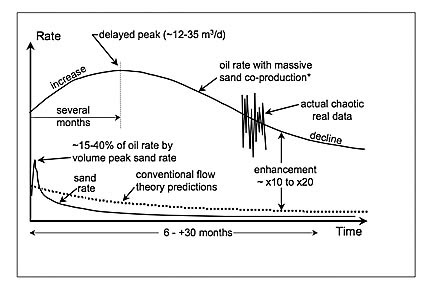
To begin with a simple point – fluid (oil and gas) will only move from one place to another if something is pushing it. (Newton’s first law). For the fluid in the reservoir under the Gulf, this force pushing the oil out is the difference in pressure between the oil in the rock, and the pressure in the well. The pressure of the oil in the rock is 12,000 psi. When the well was drilled the pressure of the mud that filled the well was over 13,000 psi and no oil moved into the well. Just before the disaster the fluid in the well was changed from mud to seawater. This lowered the pressure of the fluid in the well below that of the fluid in the rock, a differential pressure now existed, and where there was a passage through which the oil and gas could flow, and they did. The question has always been – how much?

Gas flows more easily through cracks than oil, and the disaster was first evident when leaking gas reached the drilling rig, and then ignited. The BOP then, at least partially, functioned. After the rig sank, the riser also sank, bending the pipe just above the BOP. At that time there were reports that a Coast Guard ROV examined the underwater assembly and did not see any obvious oil leaks. A couple of days later the flow was suggested at about 1,000 bd, and this then escalated to 5,000 bd. As cameras began to publicly monitor the outlet of the riser the estimates started to grow, but a not-well-publicized effort measured the flow out of the riser, and found that it was around 8,000 bd, with allowance for leaks, the overall flow was estimated to be perhaps 12,000 bd. Once the broken part of the riser was removed and a cap placed over the well, a significant portion of the escaping oil was captured and could then be measured as it flowed into the surface vessel recovering it. Those values are currently at around 15,500 bd. BP is currently planning on additional capture this week of up to another 10,000 bd, and preparing for a worst case scenario with a flow rate of 80,000 bd. These numbers vary a lot, and yet they could all be correct.

Why? Well, its called erosion, and simply put, the oil and gas that are flowing out of the rock are bringing small amounts of that rock (in the form of sand) out with them. Rocks that contain lots of oil are not that strong and are easily worn away by the flow of fluid through them.

Let me make an analogy with soil. If I make a hill of soil, and leave it sit for a while there will be a number of rainstorms fall on the soil. Initially the surface will all erode relatively evenly under the diffused flow after the rain, but very quickly weaker parts of the soil will be removed faster and instead of a smooth surface, the soil will be selectively eroded and channels or rills will start to form on the surface.


Hillside rill channels formed as initially diffuse rainwater water flow concentrates and erodes channels

These are larger than the passageways around the individual grains of soil, and so it is easier for the water to flow in these channels, and so more water collects in them and moves through them. As it does, because the fluid can easily get around the soil particles, and this was a weaker area already, more soil is removed, and the channels get deeper. This is known as concentrating the flow and means that, over time the channels grow bigger, the fluid flows faster, and it has a greater potential for erosion.

This also happens when oil and gas start to flow from a reservoir. It is generally not a good thing to allow, since the sand is still in the oil and gas when it reaches the surface and it is expensive to get out – as well as causing the problems I am about to talk about. So to stop it, the well is fitted with a screen when it is first opened. The screen holds the rock particles (sand) in place around the well, slowing if not completely stopping the creation of the channels.

But sometimes, the deposit doesn’t flow very well, the oil may be heavier, or there may be other reasons, and in this case allowing those channels to develop can help production. This technique is known as CHOPS – Cold Heavy Oil Production with Sand. (The report cited is a multi-chapter pdf). The impact of allowing the sand to flow with the oil and gas (to be produced in the terminology) is very significant.


Simplified change in production from a well with the sand being produced (upper curve) relative to conventional flow (lower curve). (The curves have been smoothed and only a sample of the “noisy” data is shown). Government of Alberta CHOPS Report

There is thus a very good reason, from the oil in the rock point of view, for the production to have been increasing the way that it has. And for it to increase to the levels that BP are taking precautions to capture. And because they cannot get access to the flow channels to restrain their growth and hold the sand until the relief wells are drilled that increase may well be unavoidable.

Now to the second part of the puzzle, which is what that sand does to the flow passages. The DOE release of some of the documents from BP included pressure measurements at different points along the BOP as taken on the 25th of May.

Pressures along the BOP on May 25th (DOE )

Because of the erosion, values only exist transiently, so dates become important.

When I cut with an abrasive slurry system, the jet flows through a nozzle that is about 1 mm in diameter (0.04 inches). With a pressure drop of 5,000 psi across the nozzle, that jet, once formed, will cut through casing steel in around 15 seconds. It will cut through ASTM – A108 steel to a depth of over an inch at a traverse speed of 1.5 inches a minute. (Cement is much easier to cut). In this way very small initial openings are very easily made wider, to allow a greater volume flow. (And for those who assert that changing material properties will stop erosion, one of my upcoming papers deals with what happens to diamond.)

The pressures across the BOP don’t show the pressure drops that they did earlier in this disaster. At one time it was reported that the pressure below the BOP was in the 8-9,000 psi range and that above it 2,800 psi with the 2,250 psi pressure being that of the seawater outside the riser. At that time I calculated that a flow of 500 gallons per minute (17,000 bd) would only require a gap in the range of 0.5 to 0.7 inches in effective diameter to allow that flow, at that pressure drop.

The pressure below the BOP is now at 4,400 psi with a pressure drop of around 2,150 psi which will slow the erosion significantly – but not totally. For that pressure drop to have occurred, for the same flow rate, the effective equivalent diameter through the BOP need only increase by 0.1 inches to 0.8 inches, which is not a lot. Were the effective diameter to increase by only another 0.15 inches the flow would increase to 25,000 bd, and if the effective diameter were to double to about 1.7 inches, then the flow would reach the maximum capacity that BP will be able to handle of 80,000 bd. Given the steady erosion that the BOP is seeing, and the fact that a slow erosion rate over time still gets to a large enough diameter, perhaps it is not foolish of BP to bring in that additional capture and storage capacity.

And since a picture sometimes helps, the following picture shows a single ASJ jet at 5,000 psi cutting the walls of the OmniMax Theater under the Gateway Arch in St Louis. We cut the full 15 ft of the new wall exposure with the system (to make the hole for the theater to be put into). The jet flow rate was around 5 gpm.


And this was the cut after a single pass, we were cutting about 18 inches deep on a cut (rock and cement cut a lot easier than metal – though we accidentally ran over a couple of those bolts and cut them right off).

Dolomite and chert cut with an ASJ in the walls of the Omnimax Theater under the Arch in St Louis. (Its all hidden behind the concrete wall now).

Now you will notice that this says nothing about those ideas such as that propounded by Dougr that the casing has been cracked and oil is escaping into the surrounding rock., and that the casing is becoming a lot weaker. There are two reasons for this, firstly if there was a crack, in the same way as with the BOP, then over time that would have been eaten away as oil, gas and mud flowed through it. Once a flow starts it will rapidly eat out a larger passage, as the above has demonstrated. Once that passage was created then oil flow through it to the surface would make it impossible to see what was going on around the well (look at the cloud above the BOP). In fact there are very clear pictures from under the BOP. This would seem to show that there is no oil leaking there at present.

The other thing to remember is that BP are planning on using the second LMRP cap effectively as a seal on the well. They could not do that if the upper segments of the casing were damaged, and I imagine that they have enough data from the Top Kill testing to reassure themselves of that.

Sense of Events: How bad will the Oil Spill get?

Sense of Events: How bad will the Oil Spill get?

How bad will the Oil Spill get?

By Donald Sensing

According to this oil industry expert, worse than you have ever imagined.

Well...none of what is likely to happen is good, in fact...it's about as bad as it gets. I am convinced the erosion and compromising of the entire system is accelerating and attacking more key structural areas of the well, the blow out preventer and surrounding strata holding it all up and together. This is evidenced by the tilt of the blow out preventer and the erosion which has exposed the well head connection. What eventually will happen is that the blow out preventer will literally tip over if they do not run supports to it as the currents push on it. I suspect they will run those supports as cables tied to anchors very soon, if they don't, they are inviting disaster that much sooner.

Eventually even that will be futile as the well casings cannot support the weight of the massive system above with out the cement bond to the earth and that bond is being eroded away. When enough is eroded away the casings will buckle and the BOP will collapse the well. If and when you begin to see oil and gas coming up around the well area from under the BOP? or the area around the well head connection and casing sinking more and more rapidly? ...it won't be too long after that the entire system fails. BP must be aware of this, they are mapping the sea floor sonically and that is not a mere exercise. Our Gov't must be well aware too, they just are not telling us.

All of these things lead to only one place, a fully wide open well bore directly to the oil deposit...after that, it goes into the realm of "the worst things you can think of" The well may come completely apart as the inner liners fail. There is still a very long drill string in the well, that could literally come flying out...as I said...all the worst things you can think of are a possibility, but the very least damaging outcome as bad as it is, is that we are stuck with a wide open gusher blowing out 150,000 barrels a day of raw oil or more. There isn't any "cap dome" or any other suck fixer device on earth that exists or could be built that will stop it from gushing out and doing more and more damage to the gulf. While at the same time also doing more damage to the well, making the chance of halting it with a kill from the bottom up less and less likely to work, which as it stands now?....is the only real chance we have left to stop it all.

It's a race now...a race to drill the relief wells and take our last chance at killing this monster before the whole weakened, wore out, blown out, leaking and failing system gives up it's last gasp in a horrific crescendo.

We are not even 2 months into it, barely half way by even optimistic estimates. The damage done by the leaked oil now is virtually immeasurable already and it will not get better, it can only get worse. No matter how much they can collect, there will still be thousands and thousands of gallons leaking out every minute, every hour of every day. We have 2 months left before the relief wells are even near in position and set up to take a kill shot and that is being optimistic as I said.

Over the next 2 months the mechanical situation also cannot improve, it can only get worse, getting better is an impossibility. While they may make some gains on collecting the leaked oil, the structural situation cannot heal itself. It will continue to erode and flow out more oil and eventually the inevitable collapse which cannot be stopped will happen. It is only a simple matter of who can "get there first"...us or the well.
And he thinks it will be the well. How much oil could blow into the Gulf if there is a total failure of the wntire wellhead and its seabed substructure? Possibly billions of barrels. That makes listening to the president's address tonight with an analytical ear even more important.

Sunday, May 30, 2010

Procrastination hack: '(10 2)*5' | 43 Folders

Procrastination hack: '(10 2)*5' | 43 Folders

Procrastination hack: '(10+2)*5'

Following on the idea of the procrastination dash and Jeff’s progressive dash, I’ve been experimenting with a squirelly new system to pound through my procrastinated to-do list. Brace yourself, because it is a bit more byzantine than is Merlin 2005’s newly stripped-down habit. It’s called (10+2)*5, and today it will save your ass.

Who it’s for

(10+2)*5

  • procrastinators
  • the easily distracted
  • compulsive web-surfers
  • people with a long list of very short tasks (a/k/a “mosquitos”)
  • people having trouble chipping away at very large tasks

What you’ll need

  1. a timer
    • must be easy to reset
    • electronic kitchen timer is particularly good (pref. with multiple alarm memories), or
    • an app like Minuteur (get the newest version—several cool new features)
  2. a reduced subset of your to-do list
    • tasks that can be worked on (not necessarily completed) in blocks of 10 minutes or less
    • GTD people: next actions only, please
  3. an hour of your time (less is potentially okay, but it’s non-canonical)
  4. your sorry, procrastinating ass

How it works

It’s called “(10+2)*5” and here’s why:

  • 10 - Work for ten minutes with single-minded focus on moving toward completion on a single task. Ten minutes, and that’s all you’re allowed to do is work, work, work. No cheating, because (DING!) you actually get a break when you’re done…
  • 2 - After ten minutes of sweaty, dedicated work you get a 2-minute break to do whatever you want—drink coffee, read 5ives, call your bookie, whatever. When the two minutes are up, it’s back to work on the next task on your list. This is important.
  • *5 - You’re going to iterate this four more times for a total of one hour’s working/breaking

Important squirrely rules

  • You do not need to finish your task or your project in ten minutes; you just need to move it forward
  • If you finish a satisfying amount of work in fewer than ten minutes, STOP, and go right to your 2-minute break, than start another 10-minute dash
  • Do NOT skip breaks! You are not allowed. Breaks cannot be missed. Period. Go surf the web. Now. Seriously. GO!

What will happen

You’ll blaze through an hour’s worth of work/not work and will find yourself looking forward to both the breaking and working parts of the cycle. (Dang, how’s that for a change?)

The MacGuffin

The Now Habit
by Neil Fiore

Okay, you caught me. That’s the hack: you can and eventually will skip breaks.

In his (extremely wonderful) The Now Habit, Neil Fiore suggests a similar habit of “unscheduling,” where you only make obligations to the things that you enjoy and that are not the source of procrastination. John Perry suggests “Structured Procrastination,” where you only give high priority to “unimportant” tasks. Of course, this is taken to a hilarious extreme with Joshua Newman’s plan for scheduling just a few minutes of work per hour, and then focusing on the “more important” tasks like DVD re-arranging.

Thursday, May 27, 2010

sad truth we need oil drillers "more than they need us" james altucher says: Tech Ticker, Yahoo! Finance

sad truth we need oil drillers "more than they need us" james altucher says: Tech Ticker, Yahoo! Finance

The Oil Drum | Drumbeat: May 27, 2010

The Oil Drum | Drumbeat: May 27, 2010

"BP sets stage for Disaster"

No oil and gas well ever drilled has gone exactly to plan, or without mistakes being made. The Upstream Industry has learned the hard way. The path to todays drilling (well construction) approach is littered with terible loss events, and awash with lessons. But the fact is that todays drilling approach allows for mistakes to be made, simply because wells do not always behave as planned, and the execution of each step of the well construction plan relies on people. Contingency measure after contingency measure is layered over the average well construction plan such that if one, two, three, or even more consecutive issues occur and stack up against the well construction team there remains the cability on hand to identify there is a problem, to secure the well, and to plan and effect an appropriate remedial plan.

Yes a number of issues were stacking up against the well contruction team on Mississippi Canyon 252 #1-01 well on the night of the tradgey. Issues such as a communication path between the reservoir (oil and gas) and the well bore, the choice of casing plan and related well barriers, etc. However up until around 21:45 there remained the cability on hand to identify there was a problem, to secure the well, and to plan and effect an appropriate remedial plan to deal with the issues that had stacked up.

Unfortunately, at around 21:47 the Annular BOP opened releasing the immense energy that had accumulated beneath it (gas), energy that on release evacuated (ejected) the drilling riser of fluids in seconds. Thousands of gallons of fluids entering the workspace (drill floor) at almost jet force would have made any subsequent action to try to regain control of the well very difficult.

Much has been made about the issues that stacked up against the well construction team on that night, the cement program, the cement quality, the casing program, the testing program, etc etc, however the point remains that until around 21:45 the team still had the ability on hand to identify there was a problem, to secure the well, and to plan and effect an appropriate remedial plan to deal with the issues that had stacked up. The BOP Annular was closed and was capable of containing pressure build up as a result of the leak path between the reservoir and the well bore. There were other BOP Ram Preventers available of high pressure rating than the BOP Annular Preventer to call upon if required. With this contingency at hand (the last layer of contingency in any well construction plan), why did it still go so wrong?

I would offer that the real question is why did the BOP annular open? Did it fail? Was it opened by mistake? Was it opened thinking there was no hazardous gas build up below it? The investigation team will undoubtedly determine the truth.

I can also offer that in the Drilling Industry the Driller (the man that operates the drilling machine integrated into the rig structure) has two Golden Rules when it comes to well control:
#1, if there is any doubt whatsoever about a possible influx of formation fluid into the well bore then the well must be shut in (close the BOP), he requires approval from no-man for this action
#2, if the BOP has been closed for whatever well activity the Driller must be assured that doing so will not result in a hazardous situation for him, his team and all with him at the worksite. He requires approval from the worksite supervisors for this action.

The mud logger charts (main drilling parameter record) for the period 20:00hrs through 21:50hrs as presented at the Senate hearing show clear indicators of a problem with the well. There was more flow coming back from the well than going in, there was additional pressure where there should not have been. Evaluation and interpretation of these charts is an essential part fo providing the Driller the assurance he needs that opening the BOP Annular will not result in a hazardous situation.

If the BOP Annular was opened by the well construction team the other question undoubtedly being asked by the investigation team is whether suitable and sufficient evaluation and interpretation of the drilling parameter records was undertaken prior to authorising the opening of the BOP Annular?

The time line on the mud logger chart suggests around 15 minutes (from 21:30hrs to around 21:45hrs) may have been available for the well construction team to evaluate and interpret why there was pressure under the BOP Annular when there shouldnt have been.

15 minutes is not a long time to consider this kind of situation. Given that there had been a number of issues going on with this well since the casing was run and cemented (a lot of red flags were flying) there should have been the highest degree of awareness on every subsequent step of the operation. This means the full attention of all supervisors at all times. So, assuming again that the BOP Annular was opened by the team, why was there only a few minutes spent deciding the next step when the biggest red flag of them all (pressure under the BOP Annular) was waving.

Thanks for reading.

Blowout

Saturday, May 22, 2010

oil-halliburton-cement-052010jpg-e618a2271a66c847.jpg (JPEG Image, 570x1024 pixels)

oil-halliburton-cement-052010jpg-e618a2271a66c847.jpg (JPEG Image, 570x1024 pixels)

Well bore sketch possible entry thought blowout Horizon

Obama's An Idiot

Obama's An Idiot

Joke

More Truth Than Bullshit

Barack Obama met with the Queen of England.

He asked her, "Your Majesty, how do you run such an efficient government? Are there any tips you can give to me?"

"Well," said the Queen, "the most important thing is to surround yourself with intelligent people."

Obama frowned, and then asked, "But how do I know the people around me are really intelligent?"

The Queen took a sip of tea. "Oh, that's easy; you just ask them to answer an intelligent riddle." The Queen pushed a button on her intercom. "Please send Tony Blair in here, would you?"

Tony Blair walked into the room and said, "Yes, my Queen?"

The Queen smiled and said, "Answer me this please, Tony, your mother and father have a child. It is not your brother and it is not your sister. Who is it?"

Without pausing for a moment, Tony Blair answered, "That would be me."

"Yes! Very good," said the Queen.

Obama went back home to ask Joe Biden, his vice presidential choice the same question. "Joe, answer this for me. Your mother and your father have a child.
It's not your brother and it's not your sister. Who is it?"

"I'm not sure," said Biden. "Let me get back to you on that one.." He went to his advisors and asked every one, but none could give him an answer. Finally, he ended up in the men's room and recognized Colin Powell's shoes in the next stall.

Biden asked Powell, "Colin, can you answer this for me? Your mother and father have a child and it's not your brother or your sister. Who is it?"

Colin Powell yelled back, "That's easy, it's me!"

Biden smiled, and said, "Thanks!" Then, he went back to speak with Obama. "Say, I did some research and I have the answer to that riddle. It is Colin Powell!"

Obama got up, stomped over to Biden, and angrily yelled into his face, "No! You idiot! It's Tony Blair!"

AND THAT MY FRIENDS IS WHAT'S WRONG WITH OUR GOVERNMENT.

Tuesday, May 18, 2010

Possible non-OPEC oil supply surge to put pressure on prices?

Possible non-OPEC oil supply surge to put pressure on prices?

To be sure, data points from only two years shouldn’t make us rush to believe that world oil is undergoing a shale gas type surge in productive capacity. In fact, it’s not. Analysis strongly suggests that the production surge in 2009 and 2010 will not repeat; in other words, non-OPEC oil output is not expected to grow in 2011 and the foreseeable future. So, against a backdrop of resurgent demand from emerging economies that means that a bias to higher oil prices over the next 12 to 24 months remains (notwithstanding another economic meltdown).

Yet those in the oil business shouldn’t be too complacent in recognizing the significance of the mini-tsunami of non-OPEC oil that hit the markets in 2009, at the same time as the financial crisis washed out the demand side. In fact, it was OPEC that took excess barrels off the market, sacrificing market share, which is why the cartel’s collective spare productive capacity tripled in the past two years, going from 2.0 MMB/d to 6.0 MMB/d.

Looking back five years ago, the opening words to my book, A Thousand Barrels a Second, were, “We are not running out of oil. We are running out of cheap oil.” Implicit in these words were that price of this vital commodity had to rise up from the then $30.00/B, because of looming scarcity in the face of rising demand.


Read more: http://www.calgaryherald.com/business/Possible+OPEC+supply+surge+pressure+prices/3037511/story.html#ixzz0oIedA3fc