Sunday, December 07, 2014

POEM: A LEGEND OF TRUTH BY RUDYARD KIPLING

POEM: A LEGEND OF TRUTH BY RUDYARD KIPLING


A Legend of Truth


Once on a time, the ancient legends tell,
Truth, rising from the bottom of her well,
Looked on the world, but, hearing how it lied,
Returned to her seclusion horrified.
There she abode, so conscious of her worth,
Not even Pilate's Question called her forth,
Nor Galileo, kneeling to deny
The Laws that hold our Planet 'neath the sky.
Meantime, her kindlier sister, whom men call
Fiction, did all her work and more than all,
With so much zeal, devotion, tact, and care,
That no one noticed Truth was otherwhere.

Then came a War when, bombed and gassed and mined,
Truth rose once more, perforce, to meet mankind,
And through the dust and glare and wreck of things,
Beheld a phantom on unbalanced wings,
Reeling and groping, dazed, dishevelled, dumb,
But semaphoring direr deeds to come.

Truth hailed and bade her stand; the quavering shade
Clung to her knees and babbled, "Sister, aid!
I am--I was--thy Deputy, and men
Besought me for my useful tongue or pen
To gloss their gentle deeds, and I complied,
And they, and thy demands, were satisfied.
But this--" she pointed o'er the blistered plain,
Where men as Gods and devils wrought amain--
"This is beyond me! Take thy work again."

Tablets and pen transferred, she fled afar,
And Truth assumed the record of the War...
She saw, she heard, she read, she tried to tell
Facts beyond precedent and parallel--
Unfit to hint or breathe, much less to write,
But happening every minute, day and night.
She called for proof. It came. The dossiers grew.
She marked them, first, "Return. This can't be true."
Then, underneath the cold official word:
"This is not really half of what occurred."

She faced herself at last, the story runs,
And telegraphed her sister: "Come at once.
Facts out of hand. Unable overtake
Without your aid. Come back for Truth's own sake!
Co-equal rank and powers if you agree.
They need us both, but you far more than me!"


POEM: THE STRANGER BY RUDYARD KIPLING

POEM: THE STRANGER BY RUDYARD KIPLING


The Stranger within my gate,
He may be true or kind,
But he does not talk my talk--
I cannot feel his mind.
I see the face and the eyes and the mouth,
But not the soul behind.

The men of my own stock,
They may do ill or well,
But they tell the lies I am wanted to,
They are used to the lies I tell;
And we do not need interpreters
When we go to buy or sell.

The Stranger within my gates,
He may be evil or good,
But I cannot tell what powers control--
What reasons sway his mood;
Nor when the Gods of his far-off land
Shall repossess his blood.

The men of my own stock,
Bitter bad they may be,
But, at least, they hear the things I hear,
And see the things I see;
And whatever I think of them and their likes
They think of the likes of me.

This was my father's belief
And this is also mine:
Let the corn be all one sheaf--
And the grapes be all one vine,
Ere our children's teeth are set on edge
By bitter bread and wine. 

Sunday, November 30, 2014

AMERICAN DIGEST Essays, News, Notes, and Quotes

AMERICAN DIGEST Essays, News, Notes, and Quotes: a_thanksgiving-barack-obama-turkey-646592.jpg
Winner iOwnTheWorld.com Most Disturbing Thanksgiving Graphic To Date Award

At the Thanksgiving table, when your friends and brain dead family members can't explain why they voted for Obama, give them this list. They can then pick a reason.

10. I voted for Obama because I believe oil companies' profits of 4% on a gallon of gas are obscene but the government taxing the same gallon of gas at 15% isn't.

9. I voted for Obama because I believe the government will do a better job of spending the money I earn than I would.

8. I voted for Obama because Freedom of speech is fine as long as nobody is offended by it.

7. I voted for Obama because I'm way too irresponsible to own a gun, and I know that my local police are all I need to protect me from murderers and thieves.

6. I voted for Obama because I believe that people who can't tell us if it will rain on Friday can tell us that the polar ice caps will melt away in ten years if I don't start driving a Prius.

5. I voted for Obama because I'm not concerned about the slaughter of millions of babies through abortion so long as we keep all death row inmates alive.

4. I voted for Obama because I think illegal aliens have a right to free health care, education, and Social Security benefits.

3. I voted for Obama because I believe that business should not be allowed to make profits for themselves. They need to break even and give the rest away to the government for redistribution as Obama sees fit.

2. I voted for Obama because I believe liberal judges need to rewrite the Constitution every few days to suit some fringe kooks who would never get their agendas past the voters.

1. I voted for Obama because my head is so firmly planted up my ass it's unlikely that I'll ever have another point of view, and since I will never have it extracted I don’t need to keep the doctor I like.

a_thanksgiving-barack-obama-turkey-646592.jpg

▶ Thanksgiving Prayer ~ Johnny Cash - YouTube

▶ Thanksgiving Prayer ~ Johnny Cash - YouTube

AMERICAN DIGEST Essays, News, Notes, and Quotes

AMERICAN DIGEST Essays, News, Notes, and Quotes: There are over seven billion souls on Earth. Only a tiny decreasing fraction of whom are white liberals. The notion that their religious worldview and its precious pieties sits firmly entrenched upon The Right Side of History is perhaps one of the most sadly comical misapprehensions of modernity. Liberalism is dying. The only question is whether it can complete its final grim chore. And to think, not even a virgin awaits.

AMERICAN DIGEST Essays, News, Notes, and Quotes

AMERICAN DIGEST Essays, News, Notes, and Quotes: Just remember that you're standing on a planet that's evolving
And revolving at nine hundred miles an hour,
That's orbiting at nineteen miles a second, so it's reckoned,
A sun that is the source of all our power.

The sun and you and me and all the stars that we can see
Are moving at a million miles a day
In an outer spiral arm, at forty thousand miles an hour,
Of the galaxy we call the 'Milky Way'.

Our galaxy itself contains a hundred billion stars.
It's a hundred thousand light years side to side.
It bulges in the middle, sixteen thousand light years thick,
But out by us, it's just three thousand light years wide.

We're thirty thousand light years from galactic central point.
We go 'round every two hundred million years,
And our galaxy is only one of millions of billions
In this amazing and expanding universe.

Saturday, November 22, 2014

How $10,000 in a Bank in 2008 – LewRockwell.com

How $10,000 in a Bank in 2008 – LewRockwell.com: How $10,000 In The Bank In 2008 Lost Over $7000 Of Wealth by 2013


How $10,000 In The Bank In 2008 Lost Over $7000 Of Wealth by 2013


Email
Print
FacebookTwitter
Share


“That’s money in the bank” is on old expression of the
surety of the value of money housed inside a banking system.  But today
savers are being clobbered by less than 1% interest being offered on
saved money + erosion of purchasing power due to inflation.


Charles Schwab, the investment guru, speaking out in The Wall Street Journal,
bemoans the low interest rates on saved money that has affected so many
retirees.  Schwab is calling for the nation’s central bank (The Federal
Reserve) to raise interest rates.


While Schwab estimates that the loss of interest income is $58
billion in annual income since 2008 ($348 billion total), that figure is
much higher when the real inflation rate is factored.


Schwab says there is $11 trillion in short-term accounts bearing very
low interest.  Schwab doesn’t reveal all of the numbers used in his
calculations, but let’s say he was factoring the difference between 5%
interest versus the less-than-1% now offered, for a difference of ~4%.
 On a compounded basis, that would amount to a loss of ~$2.915 trillion
of interest income (mercy!) over the past 6 years.


The erosion of wealth due to inflation adds to the problem.  It is
economist John Williams of ShadowStats.com who shows the real rise in
inflation (cost of living) is closer to 10% rather than the central
bank’s target inflation rate of ~2.2% which matches the Bureau Of Labor
Standards questionable inflation numbers.  (ShadowStats.com)


While Federal Reserve chairman Ben Bernanke said the economy was
recovering, his bank was masterminding the robbery of trillions of
dollars from American savers while bragging the Fed was keeping interest
rates low that (a) created a false bubble in the real estate market;
but (b) managed to keep interest on the national debt low ($400 billion
on $17 trillion).


As an aside, if the Federal Reserve raises base interest rates to
5.0% on the national debt rather than the 2.3% interest rate on that
borrowed money today then annual interest on the national debt would
rise from $400 billion to ~$850 billion and virtually throw the nation
into insolvency.


So the Federal Reserve is stuck between a rock and a hard place.  If
the Fed comes to the rescue of savers it demolishes the ability of the
Federal government to meet its obligations to make interest payments on
its $17 of accumulate debt.


The nation generates ~$2.4 trillion tax revenues and $850 billion in
interest payments would mean the country would be paying 35.4% of its
revenues just in interest payments on the national debt.


But getting back to our calculations of lost income of American
savers, it is John Williams at ShadowStats.com who calls attention to
the chicanery of the Federal Reserve that uses sleight of hand to
calculate the rate of inflation.  If inflation were calculated the way
it was done in 1980 then the real rate of inflation is closer to 10%
(~9.6% according to Williams.  (ShadowStats.com)


So savers not only lost income from interest payments but their money also lost purchasing power.


Schwab’s estimated $58 billion of money that savers were deprived of
represents less than a 1% loss of income per year on $11 trillion (about
0.0052% or one half of 1%).  So let’s calculate that savers not only
lost interest income but purchasing power as well.


Savers in the period 2008-2013 have been losing ~4% on the + side due
to low yield interest rate accounts and ~9% on the – side due to
inflation.


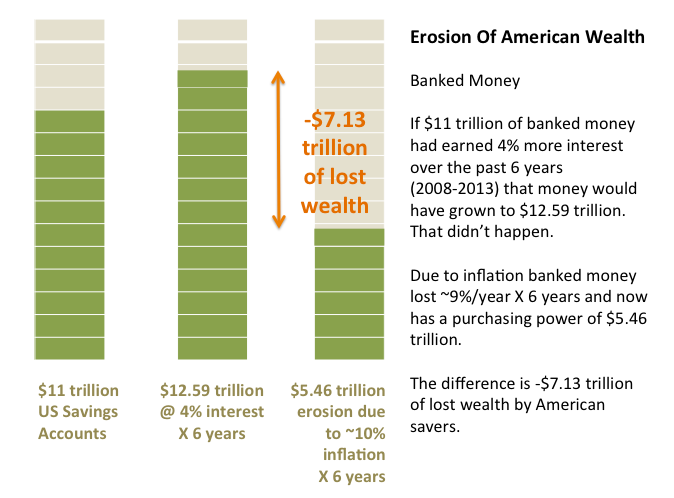
So $10,000 in the bank @5% extra interest/year X 6 years would grow
that money to $12,653 over that time.  (CalculatorSoup.com) But your
$10,000 of savings grew by less than 1% (let’s just round off and call
it 1%), so it only grew to $10,615 over that six-year time period, for a
difference of $2038 of lost income.


Additionally, the purchasing power of your banked money lost ~9% annually lost ~$5393 in purchasing power over that time. (ShadowStats.com inflation calculator)  Goods and services that cost $10,000 in 2008 amounted to $15,593 in 2013.


Your $10,000 of saved money in 2008 would have lost $2038 in income
due to low yield interest rates and $5393 in purchasing power over that
six-year time period.  That is a total loss of over $7000 from a
starting point of $10,000.


For every $1 trillion in the bank, US savers lost $153.9 billion/year
X 6 years = -$923.4 billion X 11 ($11 trillion in US bank accounts) =
$5,540,000,000,000 or $5.54 trillion in purchasing power!  Additionally
savers lost $1.590 trillion in low yield interest accounts.  Folks,
American savers have been fleeced!  Ten thousand dollars of banked money
in 2008 could have risen to $12,653 at 4% interest income but lost over
half of its purchasing power over that 6-year period of time vaporized
to less than $3000 by the year 2013.


The Federal Reserve chose to rob from savers to bail out the Wall Street investment class.


Another $6 trillion was lost by American homeowners over this same time period. (CNNMoney.com June 2011)


Good God, Americans have incurred unprecedented erosion in the value of their savings over this time period.


All the while, the news media, being minions for the banking class, chide Americans to save more money. (CBSNews.com) (What, and lose their shirt?)


Meanwhile, over the past decade, American wages have stagnated.  (TheEconomist.com Sept 6, 2014)


Some economists argue that the income of Americans has risen
significantly when you figure for increased health benefits, vacation
pay, etc.  (CNBC.com Jan 29, 2014)


But these economists use the government’s phony inflation numbers and
not every American works for a company that offers these benefits,
certainly not the self-employed. Because health insurance is partially
paid for does not mean American families can pay the rent or buy
groceries.


Over half of American wage earners today make no more than $20/hour.  (MarketWatch.com  Nov 17, 2014)


Americans earning $20/hour in 1980 ($38,400/year) would need to make $58/hour today ($111,360) to make up for inflation (US Inflation Calculator) Less than 5% of American workers make that much money per hour today.


And you wonder why the Presidential candidate Ron Paul campaigned to “end the Fed?”


345


Monday, November 10, 2014

Urban Chickens - Backyard Chicken Keeping � Urban Chickens – Backyard Chicken Keeping

Urban Chickens - Backyard Chicken Keeping � Urban Chickens – Backyard Chicken Keeping

THE WALL A LITTLE HISTORY LESSON - jdr1228@gmail.com - Gmail

THE WALL A LITTLE HISTORY LESSON - jdr1228@gmail.com - Gmail: The Wall


The Wall 

A little history most people will never know.

Interesting Veterans Statistics off the Vietnam Memorial Wall

There are 58,267 names now listed on that polished black wall, including those added in 2010.


The
names are arranged in the order in which they were taken from us by
date and within each date the names are alphabetized. It is hard to
believe it is 36 years since the last casualties.


The
first known casualty was Richard B. Fitzgibbon, of North Weymouth, Mass.
Listed by the U.S.Department of Defense as having been killed on June
8, 1956. His name is listed on the Wall with that of his son, Marine
Corps Lance Cpl. Richard B. Fitzgibbon III, who was killed on Sept. 7,
1965.


There are three sets of fathers and sons on the Wall.


39,996 on the Wall were just 22 or younger.


8,283 were just 19 years old.

The largest age group, 33,103 were 18 years old.
12 soldiers on the Wall were 17 years old.


5 soldiers on the Wall were 16 years old.


One soldier, PFC Dan Bullock was 15 years old.


997 soldiers were killed on their first day in Vietnam..


1,448 soldiers were killed on their last day in Vietnam..


31 sets of brothers are on the Wall.


Thirty one sets of parents lost two of their sons.


54 soldiers attended Thomas Edison High School in Philadelphia. I wonder why so many from one school.


8 Women are on the Wall. Nursing the wounded.


244 soldiers were awarded the Medal of Honor during the Vietnam War; 153 of them are on the Wall.


Beallsville, Ohio
​ ​
with a population of 475 lost 6 of her sons.


West Virginia had the highest casualty rate per capita in the nation. There are 711 West Virginians on the Wall.


The
Marines of Morenci - They led some of the scrappiest high school
football and basketball teams that the little Arizona copper town of
Morenci (pop. 5,058) had ever known and cheered. They enjoyed roaring
beer busts. In quieter moments, they rode horses along the Coronado
Trail, stalked deer in the Apache National Forest. And in the patriotic
camaraderie typical of Morenci's mining families, the nine graduates of
Morenci High enlisted as a group in the Marine Corps. Their service
began on Independence Day, 1966. Only 3 returned home.


The
Buddies of Midvale - LeRoy Tafoya, Jimmy Martinez, Tom Gonzales were
all boyhood friends and lived on three consecutive streets in Midvale,
Utah on Fifth, Sixth and Seventh avenues. They lived only a few yards
apart. They played ball at the adjacent sandlot ball field. And they all
went to Vietnam. In a span of 16 dark days in late 1967, all three
would be killed. LeRoy was killed on Wednesday, Nov. 22, the fourth anniversary of John F. Kennedy's assassination. Jimmy died less than 24 hours later on
Thanksgiving Day. Tom was shot dead assaulting the enemy on Dec. 7, Pearl Harbor Remembrance Day.


The most casualty deaths for a single day was on January 31, 1968 ~ 245 deaths.


The most casualty deaths for a single month was May 1968 - 2,415 casualties were incurred.


For
most Americans who read this they will only see the numbers that the
Vietnam War created. To those of us who survived the war, and to the
families of those who did not, we see the faces, we feel the pain that
these numbers created. We are, until we too pass away, haunted with
these numbers, because they were our friends, fathers, husbands, wives,
sons and daughters. There are no noble wars, just noble warriors.


Please pass this on to those who served during this time, and those who DO Care. 


I've also sent this to those I KNOW do care very much, and I thank you for caring as you do.

Monday, October 27, 2014

Your Urine is Not a Window to Your Body: pH Balancing – A Failed Hypothesis | Science-Based Pharmacy

Your Urine is Not a Window to Your Body: pH Balancing – A Failed Hypothesis | Science-Based Pharmacy:


 “If you hear someone say that your body is too acidic and you should use their product to make it more alkaline, you would be wise not to believe anything else the person tells you.”

My Dance With Cancer

My Dance With Cancer


ph prostate cancer

Thursday, October 16, 2014

Abraham Lincoln Quotes About Laws and Lawyers (including sources)

Abraham Lincoln Quotes About Laws and Lawyers (including sources)

Bankers Are Just Like Anybody Else, Except Richer by Ogden Nash - Famous poems, famous poets. - All Poetry

Bankers Are Just Like Anybody Else, Except Richer by Ogden Nash - Famous poems, famous poets. - All Poetry


Bankers

Seeking Wise Counsel | QUOTES

Seeking Wise Counsel | QUOTES

Counsel Quotes - BrainyQuote

Counsel Quotes - BrainyQuote: Consult your friend on all things, especially on those which respect yourself. His counsel may then be useful where your own self-love might impair your judgment.
Lucius Annaeus Seneca

Counsel Quotes - BrainyQuote

Counsel Quotes - BrainyQuote:

The fellowship of true friends who can hear you out, share your joys, help carry your burdens, and correctly counsel you is priceless.
Ezra Taft Benson

Counsel Quotes - BrainyQuote

Counsel Quotes - BrainyQuote:

No man is so foolish but he may sometimes give another good counsel, and no man so wise that he may not easily err if he takes no other counsel than his own. He that is taught only by himself has a fool for a master.
Hunter S. Thompson

What Does the Bible Say About Wise Counsel?

What Does the Bible Say About Wise Counsel?

Kahlil Gibran On Friendship

Kahlil Gibran On Friendship: On Friendship
Kahlil Gibran


On Friendship

 Kahlil Gibran


Your friend is your needs answered.

He is your field which you sow with love and reap with thanksgiving.

And he is your board and your fireside.

For you come to him with your hunger, and you seek him for peace.


When your friend speaks his mind you fear not the "nay" in your own mind, nor do you withhold the "ay."

And when he is silent your heart ceases not to listen to his heart;

For without words, in friendship, all thoughts, all desires, all expectations are born and shared, with joy that is unacclaimed.

When you part from your friend, you grieve not;

For that which you love most in him may be clearer in his absence, as the mountain to the climber is clearer from the plain.

And let there be no purpose in friendship save the deepening of the spirit.

For love that seeks aught but the disclosure of its own mystery is not
love but a net cast forth: and only the unprofitable is caught.


And let your best be for your friend.

If he must know the ebb of your tide, let him know its flood also.

For what is your friend that you should seek him with hours to kill?

Seek him always with hours to live.

For it is his to fill your need, but not your emptiness.

And in the sweetness of friendship let there be laughter, and sharing of pleasures.

For in the dew of little things the heart finds its morning and is refreshed.

Tuesday, October 14, 2014

The Despot Within - Taki's Magazine

The Despot Within - Taki's Magazine:


But man, proud man,

Dressed in a little brief authority,

Most ignorant of what he’s most assured,

His glassy essence, like an angry ape

Plays such fantastic tricks before high heaven

As makes the angels weep._Shakespeare.

Monday, October 13, 2014

AMERICAN DIGEST Essays, News, Notes, and Quotes

AMERICAN DIGEST Essays, News, Notes, and Quotes: An MIT linguistics professor

was lecturing his class the other day. “In English,” he said, “a double negative forms a positive. However, in some languages, such as Russian, a double negative remains a negative. … But there isn’t a single language, not one, in which a double positive can express a negative.” A voice from the back of the room piped up, “Yeah, right.”

Sunday, October 05, 2014

HappyAcres

HappyAcres


Racist things

The Top 40: Comment on Will Ebola Be Death Knell for Democrats? [Bumped]

The Top 40: Comment on Will Ebola Be Death Knell for Democrats? [Bumped]: John Keynes, an immensely talented man who's vision was ruined by self-love, saw himself clearly: "We were not aware that civilization was a thin and precarious crust erected by the personality and the will of a very few, and only maintained by rules and conventions skillfully put across and guilefully preserved. We had no respect for traditional wisdom or the restraints of custom...As cause and consequence of our general state of mind we completely misunderstood human nature, including our own."

Thursday, October 02, 2014

Are naps good for you? - Telegraph

Are naps good for you? - Telegraph

When the CDC Tells Us to Prepare for the Ebola Pandemic, Things Are About to Get Real |

When the CDC Tells Us to Prepare for the Ebola Pandemic, Things Are About to Get Real |

Are You Prepared for an Ebola Quarantine? – LewRockwell.com

Are You Prepared for an Ebola Quarantine? – LewRockwell.com

Is a Cancer Cure Being Suppressed? – LewRockwell.com

Is a Cancer Cure Being Suppressed? – LewRockwell.com: How to cure cancer and wet macular degeneration

Careful analysis shows there are three ways to halt or slow the use of sugar by cancer cells for growth. (1) Limit the amount of refined sugar in the diet, a practice that also appears to be ignored by oncologists; (2) use 3-BP to inhibit hexokinase, the key enzyme that promotes use of sugar for cellular energy in cancer cells; or (3) inhibit the initial signal that signals living cells to use sugar rather than oxygen for energy. That initial signal is produced by a gene called hypoxia-inducing factor-1 (HIF-1). [Bioscience Reports Nov 15, 2013] Hypoxia is a state of oxygen deprivation.

The very same nutraceutical mixture that has been reported to spare hopeless patients from loss of vision was found by National Institutes of Health researchers to inhibit the key growth factor (vascular endothelial growth factor or VEGF) by profoundly down-regulating its controlling microRNA 20b by -1366 fold. [PLoS One Dec 23, 2010] The nutraceutical mixture may also be an incomparable anti-cancer agent.

Is a Cancer Cure Being Suppressed? – LewRockwell.com

Is a Cancer Cure Being Suppressed? – LewRockwell.com: 3-bromopyruvate

3-bromopyruvate - Google Search

3-bromopyruvate - Google Search


cancer treatment

Wednesday, September 24, 2014

Curmudgeonly & Skeptical presents Boned Jello

Curmudgeonly & Skeptical presents Boned Jello:


Richard Cory
They say that Richard Cory owns one half of this whole town

With political connections to spread his wealth around

 Born into society, a banker's only child

He had everything a man could want: power, grace, and style

But I work in his factory

And I curse the life I'm living

And I curse my poverty

And I wish that I could be

Oh I wish that I could be

Oh I wish that I could be
Richard Cory

He freely gave to charity, he had the common touch

And they were grateful for his patronage and they thanked him very much

So my mind was filled with wonder when the evening headlines read:

"Richard Cory went home last night and put a bullet through his head"

Saturday, September 13, 2014

The Wind in the Heights @ AMERICAN DIGEST

The Wind in the Heights @ AMERICAN DIGEST


Who has seen the wind?

Neither you nor I.

But when the trees bow down their heads,

The wind is passing by.


           -- Christina Rossetti


10,000 FEARED DEAD

-- Headline, New York Post, September 12, 2001


AT THE TURN OF THE CENTURY I lived in Brooklyn Heights in, of course,
Brooklyn. The opening of the Brooklyn Bridge on May 24 of 1883
transformed the high bluff just to the south of the bridge into
America's first suburb. It became possible for affluent businessmen from
the tip of Manhattan which lay just over the East River to commute
across the bridge easily and build their stately mansions and townhouses
high above the slapdash docks below. Growth and change would wash
around the Heights in the 117 years that followed, but secure on their
bluff, on their high ground, the Heights would remain a repository old
and new money, power, and some of the finest examples of 19th and early
20th century homes found in New York City.


When I moved to Brooklyn Heights from the suburbs of Westport,
Connecticut in the late 90s, it was a revelation to me that such a
neighborhood still existed. Small side streets and cul-de-sacs were
shaded over by large oaks and maple that made it cool even in the summer
doldrums. Street names such as Cranberry, Orange and Pineapple let you
know you were off the grid of numbered streets and avenues. Families
were everywhere and the streets on evenings and on weekends were full of
the one thing you rarely see in Manhattan, children.


Brooklyn Heights had looked down on Wall Street and the tip of
Manhattan from almost the beginning. It hosted the retreat of Washington
from New York City during the Battle of Long Island, the first major
engagement of the Revolutionary War. To be in the Heights was to hold
the high ground and all the advantages that position affords.


Brooklyn Heights today enjoys a kind of armed hamlet existence in New
York. Outside influences such as crime, poverty and ghetto life don't
really intrude. Since it has long been a neighborhood of the rich and
the powerful of the city, it has been spared some of the more doleful
effects of city life. It doesn't have walls that you can see, but they
are there, strong, high and well guarded.


Traffic, that bane of New York life, is controlled in the Heights. To
the west, the Brooklyn Queens Expressway, once planned to cut through
the Heights directly to the Brooklyn Bridge, was rerouted by a deft
application of money and power; placed below along the harbor. To the
east, all traffic coming off the Bridge is pushed along Cadman Plaza to
Court Street and off to Atlantic. This forms the eastern border of the
Heights whose edge is further delineated by the ramparts of Brooklyn
City Hall, Courts of all flavors and a rag-tag collection of government
structures that exemplify the Fascist Overbuilding movement of the early
70s when, expecting 'The Revolution,' governments built towards
gun-slits rather than windows. The south of the Heights is sharply
drawn with Atlantic Avenue, a street given over to a long strip of
fringe businesses and a corridor of Islamic-American mosques and souks
and restaurants. The north is quite simply the Brooklyn Bridge and its
approaches that shelter the now slowly evolving sector devoted to
overpriced raw loft spaces and bad art known as DUMBO, for "Down Under
the Manhattan Bridge Overpass."


The best thing about the Heights is the Promenade. This is a long
pedestrian strolling area that runs from Remsen on the south to
Cranberry on the north end. It's a brick walk high on the bluff above
the Expressway below. Over the baroque railing you can see far out into
the harbor, beyond the Financial District and Wall Street on the tip of
Manhattan, beyond the Statue of Liberty and Ellis Island to the distant
silhouettes of the cranes and wharfs on the Jersey Shore. You can see
north up the East River past the Brooklyn Bridge and the Manhattan
Bridge to, maybe, the merest wisp of the Williamsburg Bridge. Across
from the railings are a selection of gardens and backyards with water
fountains and shaded benches. It is one of those hidden, off-to-the-side
areas of respite that are secreted across all the seven boroughs of the
city. You discover it by being taken to it by someone else who has
already been there.


The Promenade is a fine place on any day but best on a Sunday
afternoon when the weather is clear. Then you can stroll with your
fellow citizens and catch a bit of the constant breeze or a bracing
wind. Under most conditions, this wind is one of the best elements of
Brooklyn Heights. Usually you just take it for granted -- as you do all
the small mercies of life in New York City.


When the wind came from the south off the harbor those who lived on
the Heights got to breathe the sea air first before the rest of the
city had its way with it. And it usually did blow from the south even
if there were days when it blew in from the west across the southern tip
of Manhattan. At least, I think that it did on numerous days even if I
only remember it from one.


I don't remember the wind from that day because it blew hard and
long. The winter, spring and fall brought many blizzards and storms to
the Heights with winds that would howl over the roofs and pulse in the
chimney of my parlor floor apartment. In winter it would slam against
the stones of the facade and rattle the windows while rolling snow so
fine against the door that a dusty drift would work its way through the
weather stripping and into the foyer by morning.


So if I think about the storms I can say they always came to the
Heights on the big shoulders of a bigger wind, but I don't really
remember any one of those winds. In my memory, I just assume they were
there, a part of the storm. Winds always are a part of any storm. Just
as the French say "Never a rose without a thorn," so "Never a storm
without a wind."


Except once and then the storm came later. And even if that wind has
now become a faint foreign breeze moving over a distant landscape of
sand and rubble and blood, it rolls along still and will in time make
its way back to where it began.


The wind came when the pillar of fire became, in what seemed a moment
outside of time, a pillar of smoke. We had been standing on the
Promenade that morning in our thousands watching death rage at the
center of a beautiful September morning. It was a morning with a clear
and washed blue sky; the kind of rare New York morning when you can
believe, again, that anything is possible in that city of dreams that so
often dissolve into disappointment.


Anything, of course, except the two towers whose peaks were engulfed in flames.


Anything, it would seem, but what we were seeing.


And it was a morning, as I recall, that had no wind at all. That was
why the flames and the smoke from the flames went almost straight up
into the sky, a long sooted streak that bisected one side of the blue
sky from the other.


It was, except for this one insane thing happening in the middle of
our panoramic view from the Promenade, a most beautiful day; made even
more so by the absence of any irritating noise from passenger jets
overhead.


The last two jets into New York airspace that morning would be the
last for days to come. In New York you become so used to the sound of
jets overhead in New York that you don't really hear them. What you did
hear on that day was the silence of their absence. When the sound of
jets came back later that afternoon it was not the sound of passenger
jets but of F-16 fighters, and we were glad to hear them.


But in that mid-morning all we could see and think about were the
souls trapped in the twin torches about a quarter of a mile away from us
on the other side of the East River.


At a certain point in that timeless time you noticed that specks were
arcing out from the sides of the buildings from just above or just
below or just within the part that was in flames. Looking again you saw
that the specks were people flying out from the building and plunging
down the sides to disappear behind the shorter buildings that ringed the
towers. You tried to imagine what must have been going on in the
offices and rooms of that building that made leaping from 100 floors or
more above the ground the "better" option, but you didn't have that kind
of space left in your imagination. And so you looked on and watched
them leap and distantly, silently fall, locked within that morning that
had no time, in which all of what you had known, believed, and trusted
in came, at once and forever, to a sudden frozen halt.


And then the first tower came down.


We've all seen, most of us on television, what happened next. We've
all seen the dropping of the top floors into the smoke and then the
shuddering impact and then the rolling and immense cloud of ash that
exploded up the island of Manhattan overtaking thousands running north
and laying thick slabs of ash over everything in its wake. The tape was
played and replayed until, by order or consensus, it stopped being
played. World Trade Center and north up the island -- center stage in
death's carnival on that day.


That wasn't for me. I was part of the sideshow in Brooklyn Heights.


Lower Manhattan is a welter of thin 17th century streets lined with
tall 19th and 20th century buildings. When you take the mass of two
buildings the size of the Twin Towers, heat it to the point that steel
bends, and drop it straight down into the center of this maze, it does
not all go just one direction even if that's where the video cameras
are. It moves out radially in all directions. Standing on the Promenade
you are in front of many different channels for this atomized mass and
the plumes of smoke and what it holds will come at you. And it did, very
fast and very dark.


It seemed to come out of the streets that opened onto the South
Street Seaport like some Titan's grime clotted fingers, and roiled
across the river as if the distance was a few hundred feet rather than a
few thousand yards. You saw what was coming and you turned to flee from
this black wind with no storm, but there were thousands of others who
had come to watch and they too were turning to run out of the exits from
the Promenade that had, moments before seemed broad, but now impossibly
narrow.


As the wind-driven cloud came over us and things became murky then
dark, panic began and shouts and screams could be heard inside the dense
smoke. Through some miracle, the crowd ordered itself and those who had
brought children with them were eased out in the sudden darkness and
others followed in a rapid order. The cloud lightened and then darkened
again and the wind rose and fell away and came back. It rippled your
clothing, and the smoke must have had a smell to it because it hurt the
lungs when you breathed, but I don't remember the smell only the
sensation of small needles in my lungs and the gray mucus that came up
when I coughed.


The wind pummeled my back for the five minutes it took me to make my
way to my apartment, get inside and shut the windows. I stood there at
the windows and watched the others rush by, blurs in the smoke, and
noticed when, as suddenly as it had come up, the wind died away and the
air was almost still. The smoke and the ash still moved in the street
outside and high overhead. The day was still darkened but the initial
violence of the blast and the wind had passed.


In time, everyone had passed by as well and the street was empty
except for the settling smoke. I looked outside the window where a
Japanese maple grew and noticed that its wine-dark leaves were covered
with small yellow flecks. I looked down at the sill outside the windows
and saw the yellow flecks there as well.


At some point in the next few minutes it dawned on me that there
would be few bodies found in the incinerating rubble across the river. I
knew then -- as certainly as I have even known anything -- that all
those who had still been in the towers had now gone into the flame and
the smoke and that, in some way, the gleaming bits of yellow ash were
their tokens, were what they had become in that plunging crematorium.


And I knew that all they had become had fallen upon us as we ran in
the smoke; that we had breathed them in when the wind reached us; that
they were covering the houses and the sills and the cars and the
sidewalks and the benches and the shrubs and the trees all about us.


What they had become was what the wind without a storm had left
behind. Now that the wind had passed everything was, again, silent and
calm. The blue sky above the houses on Pierrepont Street in Brooklyn
Heights were beginning to emerge from the fading smoke as the breeze of
the harbor shifted the plume away from us, moving it north, uptown, into
Manhattan, leaving the Heights again as an elite enclave, above and to
the side of New York City.


The yellow flecks remained, resting like small stars on the surface
of everything in the Heights for three days until the first rains came
on a late afternoon to wash them away. I walked out into that rain and
back down Pierrepont Street to the Promenade where for months yet to
come the fires would burn across the river.


The rain came straight down that day. There was no wind. As I walked
down the sidewalk I noticed the rainwater washing those yellow flecks
off the trees and the buildings and moving down the gutter to the drains
that would take it on to the harbor and on to the sea. And that water
was -- for only a minute or so before it ran clear -- golden.


Posted by Vanderleun at September 13, 2014 2:21 AM


Bookmark and Share

Tuesday, September 09, 2014

Global Warming

When Science is Settled - by Government :: SteynOnline: When Science is Settled - by Government

by Mark Steyn
September 1, 2014

The Man Who Carried the Dark Lantern @ AMERICAN DIGEST

The Man Who Carried the Dark Lantern @ AMERICAN DIGEST

The Man Who Carried the Dark Lantern @ AMERICAN DIGEST

The Man Who Carried the Dark Lantern @ AMERICAN DIGEST

Serenity Prayer

AMERICAN DIGEST: Comment on The Man Who Carried the Dark Lantern:

God grant me the serenity
to accept the things I cannot change;

 courage to change the things I can;
and wisdom to know the difference.

Living one day at a time;
Enjoying one moment at a time;

Accepting hardships as the pathway to peace;

Taking, as He did, this sinful world
as it is, not as I would have it;

Trusting that He will make all things right
if I surrender to His Will;

That I may be reasonably happy in this life

and supremely happy with Him
Forever in the next.

Amen.

--Reinhold Niebuhr

Wednesday, September 03, 2014

AMERICAN DIGEST: Comment on The Burning Hellcat

AMERICAN DIGEST: Comment on The Burning Hellcat: When a warrior fights not for himself, but for his brothers, when his most passionately sought goal is neither glory nor his own life’s preservation, but to spend his substance for them, his comrades, not to abandon them, not to prove unworthy of them, then his heart truly has achieved contempt for death, and with that he transcends himself and his actions touch the sublime. That is why the true warrior cannot speak of battle save to his brothers who have been there with him. The truth is too holy, too sacred for words. -- Stephen Pressfield

From "Courage, as essay for Memorial Day:

Friday, August 22, 2014

AMERICAN DIGEST Essays, News, Notes, and Quotes

AMERICAN DIGEST Essays, News, Notes, and Quotes:


38 million black Americans commit five times as many violent crimes on 197 million whites as they receive, what you discover is that black perpetrators violently assault White victims TWENTY-FIVE times more frequently. When it comes to a specific kind of violent crime -- aggravated assault -- the number of black on white crimes is TWO HUNDRED TIMES HIGHER than white on black crimes. Oh, there’s an epidemic of racial violence in America, all right.

Tuesday, August 19, 2014

Thursday, August 07, 2014

I will not teach my kids about safe sex because there is no such thing | The Matt Walsh Blog

I will not teach my kids about safe sex because there is no such thing | The Matt Walsh Blog: we call these alcohol-fused humping sessions ‘safe,’ so long as they involve a layer of latex and a dose of steroids. We tell young people to wear condoms to protect against ailments like hepatitis and AIDS. The obvious insinuation here is that there is a ‘safe’ way to fornicate with a diseased stranger.

Poems - 'The Gods of the Copybook Headings'

Poems - 'The Gods of the Copybook Headings'

Sunday, July 27, 2014

A cunning way to deliver malware | Malwarebytes Unpacked

A cunning way to deliver malware | Malwarebytes Unpacked


Sometimes Kaspersky Rescue Disk 10 can clean up badly infected systems.

There's a YouTube video on how to download the Rescue disk and move the ISO image to a CD or flash drive,


virus

Saturday, July 19, 2014

Untitled Page

Untitled Page


Kent Riley Meridian

United 232 and the Miracle in a Cornfield | RealClearPolitics

United 232 and the Miracle in a Cornfield | RealClearPolitics

The 48 Laws of Power: Robert Greene, Joost Elffers: 9780140280197: Books - Amazon.ca

The 48 Laws of Power: Robert Greene, Joost Elffers: 9780140280197: Books - Amazon.ca: 1. Never outshine the master
2. Never put too much trust in friends, learn how to use enemies
3. Conceal your intentions
4. Always say less than necessary
5. So much depends on reputation - guard it with your life
6. Court attention at all cost
7. Get others to do the work for you, but always take the credit
8. Make other people come to use - use bait if necessary
9. Win thru your actions, neer thru argument
10. Infection: Avoid the unhappy and unlucky
11. Learn to keep people dependent on you
12. Use selective honesty and generosity to disarm your victim
13. When asking for help, appeal to people's self interest, never to their mercy or gratitude
14. Pose as a friend, work as a spy
15. Crush your enemy totally
16. Use absence to increase respect and honor
17. Keep others in suspended terror: cultivate an air of unpredictability
18. Do not build fortresses to protect yourself - isolation is dangerous
19. Know who you are dealing with - do not offend the wrong person
20. Do not commit to anyone
21. Play a sucker to catch a sucker - seem dumber than your mark
22. Use the surrender tactic: transform weakness into power
23. Concentrate your forces
24. Play the perfect courtier

How To Tell Your Story In 30 Seconds - Business Insider

How To Tell Your Story In 30 Seconds - Business Insider

"Take your resume and LinkedIn profile and go through it thoroughly," says McDonald. If you're unemployed, focus on where you want to go and what you want to do.

Thursday, July 17, 2014

AMERICAN DIGEST Essays, News, Notes, and Quotes

AMERICAN DIGEST Essays, News, Notes, and Quotes: REPEAT UNTIL YOU COMPREHEND: All high-level politicians in the for U.S. today are PSYCHOPATHS AND WHORES who are in it solely for the money and power. Aspiring to or holding high level office today is proof positive of the psychological and moral unfitness of the given person to hold high public office. This axiom transcends and applies equally to the facades known as the Republican and Democrat parties, and any and all antagonism between the two is nothing more than KABUKI THEATER. On Jamie Dimon, Sewage, and Other Variety | Barnhardt